
Most first trips to Istanbul are built around a single square kilometre. Hagia Sophia, the Blue Mosque, Topkapı Palace and the Grand Bazaar sit within a fifteen-minute walk of one another, and that convenience is the problem: by mid-morning the queues have set, and by lunchtime you move at the pace of whichever tour group is in front of you.
Twenty minutes across the water, the city changes register. Kadıköy is a district of 458,573 people on TÜİK's 2025 count, and just under 21% of them are over 65 — the fingerprint of a settled, lived-in place rather than a visitor zone. Nobody in Moda is performing Istanbul for anyone, and that is why this shore deserves a whole day rather than a spare afternoon.
The 20-minute crossing that resets the day
Şehir Hatları runs Kadıköy from Karaköy, Eminönü and Beşiktaş, roughly every 15 to 20 minutes, from about 06:10 until nearly 01:00. Karaköy to Kadıköy takes about 20 minutes; from Eminönü allow 20 to 25. The İstanbulkart fare on all three routes is 65.21 TL, and 62.70 TL from Kabataş or Üsküdar — around €1.15 at early-September 2026 rates. Those are the live figures, taken after the 10% city-wide rise of 20 July 2026, so if a guide still quotes 49 TL for this crossing, it is stale. Pay with a contactless bank card and you are billed at the limited-use rate on two passes, which costs roughly double.
The alternative makes the argument by itself. Sultanahmet to Kadıköy is 28 to 30 km by road over a Bosphorus bridge — 40 to 60 minutes when traffic behaves, longer when it does not. The ferry does it in twenty, past the Topkapı headland and the Maiden's Tower. If the day is chauffeured, the graceful version is to be dropped at the European pier and met on the Kadıköy side; an Istanbul private daily tour is routinely built exactly that way.
Arrive hungry: the market streets behind the terminal
Kadıköy's market was never built for visitors; it is where the neighbourhood shops. The grid behind the ferry terminal — Güneşlibahçe, Serasker and the lanes between them — packs fishmongers, pickle shops, cheesemongers, roasters and bakeries into a few hundred metres, and prices are set by residents who come back weekly.
The anchor is Çiya Sofrası at Güneşlibahçe Sokak 43, open 11:00 to 22:00. Musa Dağdeviren has run it since 1998 as something closer to fieldwork than restaurant-keeping, collecting vanishing regional recipes from across Anatolia and putting them on a steam table — which is how an episode of Netflix's Chef's Table came to be filmed here. Order by pointing, and take small portions of several stews.
A serious table without leaving the neighbourhood
If the day should end with dinner that would hold its own in any European capital, Moda has that too. Aida — vino e cucina, on Ressam Şeref Akdik Sokak and founded by the Rome-born chef Valentino Salvi, holds a MICHELIN Bib Gourmand in the Guide's 2026 Türkiye selection — the value category, which expanded to 39 addresses nationally that year. Book ahead.
For the older ritual, Baylan on Muvakkithane Caddesi has stood here since 1961, the last branch of the house founded by Filip Lenas. Ask for the Kup Griye, the caramel-and-vanilla sundae with burnt-almond sauce he devised in 1954.
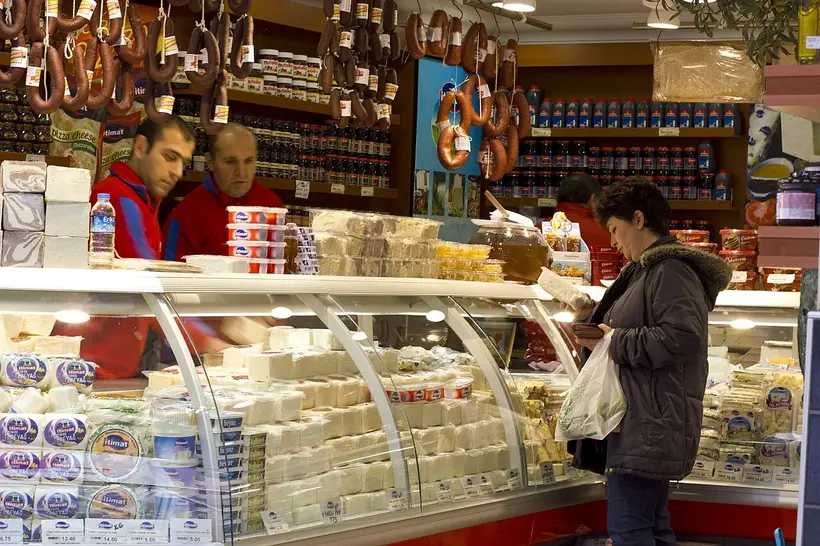
A cheese and charcuterie counter in the Kadikoy market, the everyday food grid behind the ferry terminal - photo: William Neuheisel / Wikimedia Commons / CC BY 2.0
Moda: a nostalgic tram, a 1917 pier and a library over the water
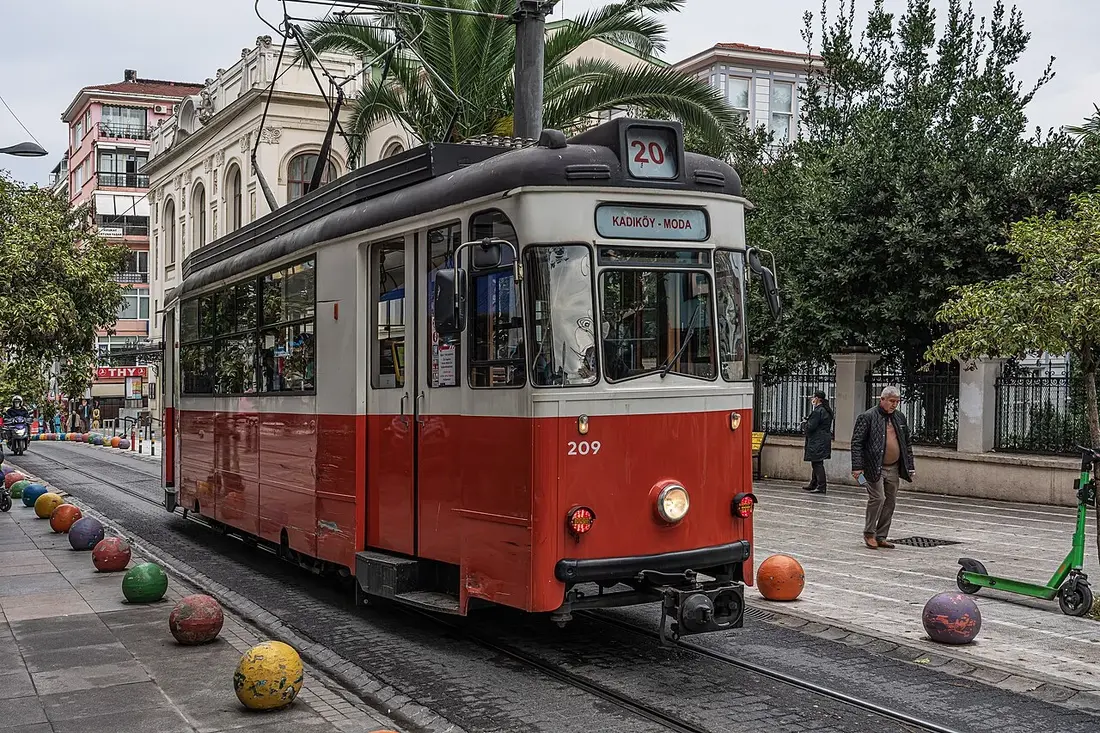
Moda starts ten minutes' walk south of the terminal, and the pleasant way in is the T3: a 2.6 km loop worked by six restored Tatra GT6 cars bought second-hand from Jena, calling at 11 stops. A circuit takes 20 minutes and the line carries around 4,000 people a day, running 06:55 to 21:00 on weekdays, 08:30 to 21:00 on Saturdays and 10:00 to 20:00 on Sundays. It is transport residents use, not a heritage ride with its own ticket booth.
At the bottom of the hill is the reason to keep walking. Moda Pier was designed by Vedat Tek — architect of the Haydarpaşa and Kadıköy ferry terminals — and built in 1916–17. It served as an English yacht club, a seafront casino and a restaurant, lost its ferry duties in 1986 and closed in 2015. On 19 August 2022 it reopened as a municipal library and book-café: a 250 m² reading room upstairs holding 6,500 volumes, a café and performance space below, the Marmara on three sides, and no entry charge.
From there the shoreline path runs unbroken through Moda, Kalamış and Dalyan — about 8 km one way, walking and cycling lanes kept separate. Forty minutes of it, as far as the Moda tea garden at sunset with the Princes' Islands in silhouette, is the version people remember, and the stretch we work into a romantic Istanbul itinerary when a couple wants the city without the crowds.
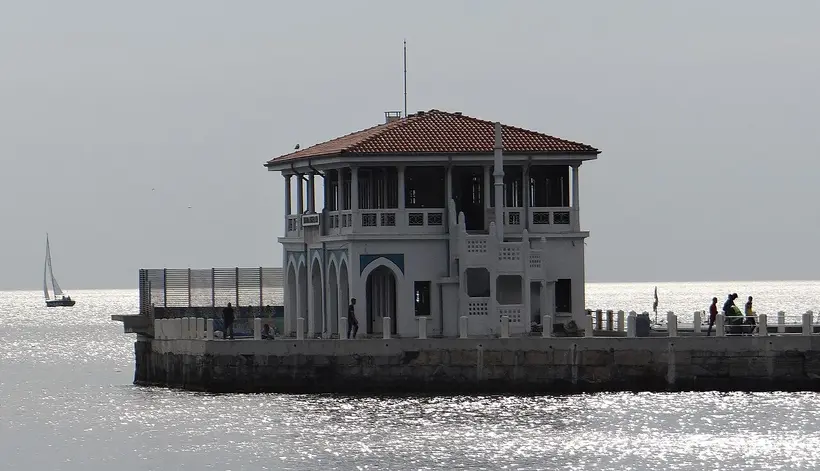
Moda Pier, built to Vedat Tek's design in 1916-17 and reopened in August 2022 as a municipal library and book-cafe - photo: HalitBaris / Wikimedia Commons / CC BY-SA 4.0
Yeldeğirmeni, Hasanpaşa and the culture that never left
Ten minutes inland, Yeldeğirmeni is the closest Istanbul comes to an open-air gallery: the Mural Istanbul festival has painted its facades since 2012, leaving 18 large-scale works by 16 international and 7 Turkish artists on its late 19th-century apartment blocks.
On Bahariye Caddesi, the Süreyya Opera House is worth timing a visit around. Süreyya İlmen built it in 1924 after touring European theatres — the foyer copies the Théâtre des Champs-Élysées — and it opened on 6 March 1927 with 570 seats. The stage machinery was never finished, so it spent decades as a cinema, reopening as a working opera house on 27 October 2007. A seat costs a fraction of the equivalent in Vienna or Milan.
Two more fold in easily. The Barış Manço House at Yusuf Kamilpaşa Sokak 5 preserves the home of a musician who means to Turks roughly what David Bowie means in Britain. It opens 09:00 to 16:00 with last entry at 15:30, closes Mondays and public holidays, and costs 82 TL, or 49 TL for students — tickets through Mobilet online only, no box office, and a Müzekart will not get you in. In Hasanpaşa, Müze Gazhane occupies a 130-year-old gasworks now holding a Climate Museum, a Cartoon and Humour Museum and a children's science centre — free apart from the theatre, closed Mondays, open 09:00 to 18:00 on weekdays and 10:00 to 18:00 at weekends.
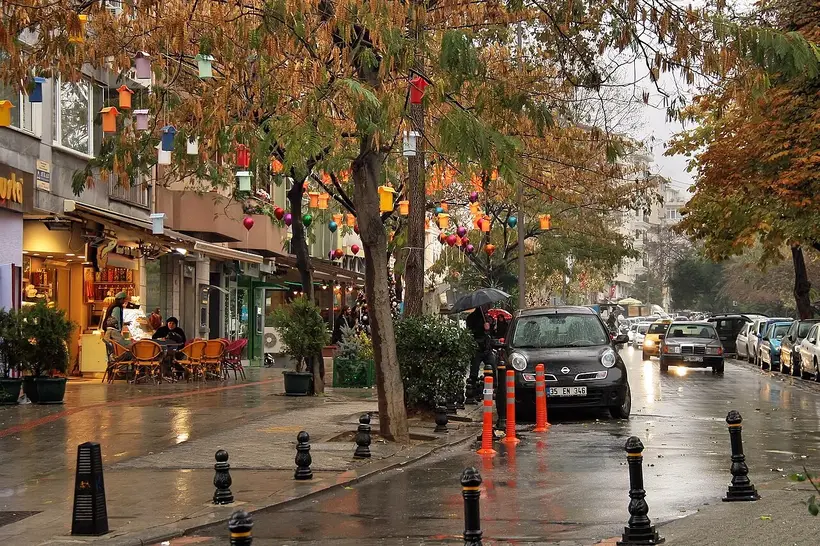
Cafe tables and hanging birdhouses on a wet December afternoon in Moda - photo: Jorge Franganillo / Wikimedia Commons / CC BY 3.0
Haydarpaşa: the biggest thing happening on this shore
Haydarpaşa station, the great 1909 terminus standing in the water, has been under restoration for years and is the one item here worth checking before planning around it. As of June 2026 the conservation of its three sea-facing façades was finished and the scaffolding came down, while strengthening, fit-out and landscaping continue.
What is going up beside it matters more. Excavations have produced Byzantine harbour structures, roads, graves and church remains, and a roughly 10,000 m² archaeology museum is being built on the site — the first on Istanbul's Asian side. Officials say they are aiming to open the bulk of the first phase around the Istanbul Culture Route Festival, which runs 26 September to 4 October 2026. Treat that as a target rather than a booking.
How to shape the day
09:30 — Ferry from Karaköy or Eminönü; stand at the stern for the view back at the old city.
10:00 — The market streets, while the fishmongers are still icing their counters.
12:00 — Lunch at Çiya.
13:30 — The T3 loop into Moda, then Bahariye Caddesi on foot for the opera house and bookshops.
15:00 — Müze Gazhane or the Barış Manço House, remembering the 15:30 last entry at the latter.
17:00 — Moda Pier and the shoreline walk, timed so the sun sets over the Islands.
20:00 — Dinner in Moda, then the late ferry back, or a private Bosphorus night cruise to finish on the water.
What a private guide and a waiting car actually change
Kadıköy is easy to reach and genuinely hard to read. The market carries almost no English signage, the exceptional stalls look identical to the ordinary ones, and half of what makes Çiya remarkable is knowing which four dishes to take out of thirty. A guide here is not walking anyone between monuments — there are barely any — but translating a working neighbourhood: what is in season, which pickle shop has been there sixty years, what the mural on that gable is arguing about. The transport half is more prosaic and worth as much, because a day like this ends two or three kilometres from where it began, after dark and usually carrying something from the market. It is also why the district pairs well with a guided historical Istanbul tour on a separate day: the old city rewards a guide who knows the queues, Kadıköy one who knows the neighbourhood.
Practical notes worth checking first
Mondays are thin. Müze Gazhane and the Barış Manço House both close; any other day is better.
Tuesday and Friday are market days in Hasanpaşa. The Salı Pazarı on Uzunçayır Caddesi sells produce on Tuesdays and textiles, bags and fabric on Fridays — the natural pairing with an Istanbul shopping day if buying is the point.
Carry an İstanbulkart. It covers ferries, the T3, the metro and Marmaray, and costs roughly half what a bank card does on the water.
The tram stops early. Last T3 runs are 21:00, 20:00 on Sundays; ferries continue until nearly 01:00.
Sabiha Gökçen is on this side. The M4 runs Kadıköy to the airport with no change: 33.5 km, 23 stations, 52 minutes end to end. Istanbul Airport is about 55 km across the city, so do not leave Kadıköy late if you fly from IST.
The case for Kadıköy and Moda is not that they beat Sultanahmet, but that they are the other half of the same city — the half most itineraries quietly drop. One ferry ticket at 65.21 TL, one unhurried day, and Istanbul stops being a monument circuit and starts being a place where people live.