
Istanbul rewards visitors who stay put — and then it wears them down. By the fourth day most people have walked the Sultanahmet loop, crossed the Bosphorus twice and eaten more than they intended. The remedy is not another mosque. It is leaving for exactly one day and being back in time for dinner.
What surprises people is how far that day reaches: a freshwater lake 33 metres above sea level, a valley where waterfalls run between the lunch tables, and a UNESCO-listed Ottoman capital under a 2,543-metre mountain, all within a two-hour drive of your hotel lobby.
What a private day excursion from Istanbul actually costs
Start with the number that changes every comparison: these prices are quoted per group, not per person.
The Sapanca and Maşukiye private daily tour starts at €250 per group for a ten-hour day, door to door. The Bursa and Uludağ private daily tour is €269 per group for ten hours, or €315 for the twelve-hour version. Both carry 8–14 guests and 6–10 suitcases in a Mercedes-Benz Vito, Sprinter or larger coach, with an English- or Arabic-speaking driver, live WhatsApp monitoring, and a 24-hour minimum booking window.
Divided among six travellers, €269 is about €45 a head for a vehicle that waits all day — the honest comparison being not a coach seat, but the taxis, train tickets and dead hours of assembling the same day yourself.
Exclusions matter as much: park entry, cable car tickets, museum admissions and every meal are paid separately. On the Bursa route, budget two optional extras — roughly €40 for a ferry crossing instead of the motorway, about €100 for a private vehicle up the summit road.
Sapanca and Maşukiye: a lake, a waterfall and a trout lunch
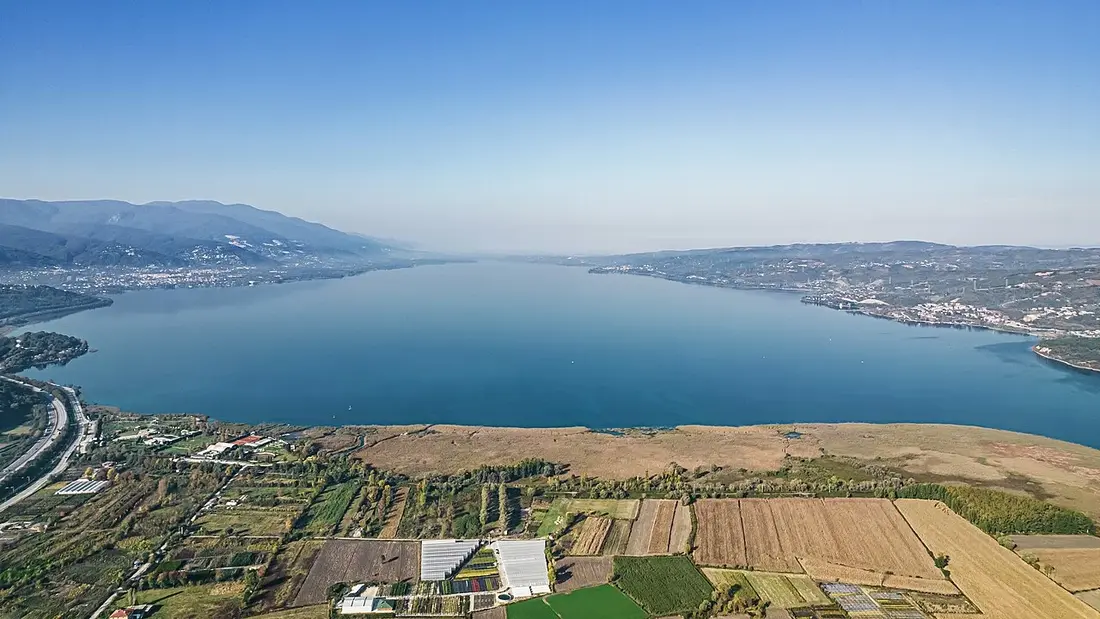
Lake Sapanca covers roughly 45 square kilometres and sits just 33 metres above sea level, about 135 kilometres east of Istanbul — close enough that you can be on its shore ninety minutes after leaving your hotel, traffic permitting.
The lake is the overture. Maşukiye, in Kocaeli's Kartepe district, is where the day earns its reputation: a narrow green valley with a stream through it and small waterfalls that the restaurants have simply built themselves around. You eat with water audible under the floorboards. Order kiremitte alabalık — trout baked and served on a scorching clay tile, usually lifted from the restaurant's own pools — with kiremitte köfte, honey and clotted cream, and village bread.
Above the valley Kartepe climbs to 1,602 metres. In winter it is a ski hill; the rest of the year the summit road is worth taking for the view back down over the lake. Zip lines and ATV tracks are on hand for teenagers — both sit outside the tour price, so agree the cost before anyone straps in.
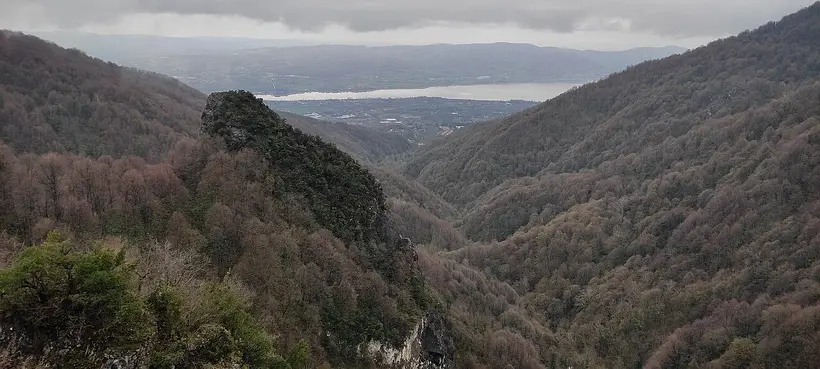
The forested Kartepe ridge above Maşukiye, with Lake Sapanca on the horizon - the valley most private day trips from Istanbul are built around. Photo: Onur capıt / Wikimedia Commons / CC BY-SA 4.0
Bursa: the first Ottoman capital, done properly in a day
Bursa is about 152 kilometres from Istanbul — roughly an hour and forty minutes down the O-7 and O-5 motorways and across the Osmangazi Bridge. Since 1 July 2026 a car pays 1,170 TL to cross, charged both ways, so 2,340 TL for the return. On our private tours, bridge and highway tolls such as this one are not included in the price and are paid separately.
The Ulu Cami was finished in 1399 for Bayezid I, who had vowed twenty mosques if he won at Nicopolis in 1396 and settled on one mosque with twenty domes on twelve enormous piers. Its ablution fountain sits inside the prayer hall under an open dome rather than out in a courtyard, and the calligraphy on its walls is among the finest in Turkey. Five minutes away, Koza Han has traded since 1491, built by Bayezid II for the silk-cocoon merchants who made Bursa the Ottoman silk capital; its courtyard is still the best place in the city for a tea.
Then Cumalıkızık on the lower slopes of Uludağ: founded around 1300, roughly 270 surviving historic houses leaning over lanes barely wide enough for a car. On 22 June 2014 it became the 998th site on the UNESCO World Heritage List, within the nomination “Bursa and Cumalıkızık: the Birth of the Ottoman Empire”. Take breakfast here — it is the sensory high point of the day.
Two stops fill the afternoon without straining it: the tombs of Osman Gazi and Orhan Gazi, and the İnkaya plane tree — around 600 years old, 35 to 36 metres tall, its trunk 9 to 15 metres in girth, with a tea garden underneath.
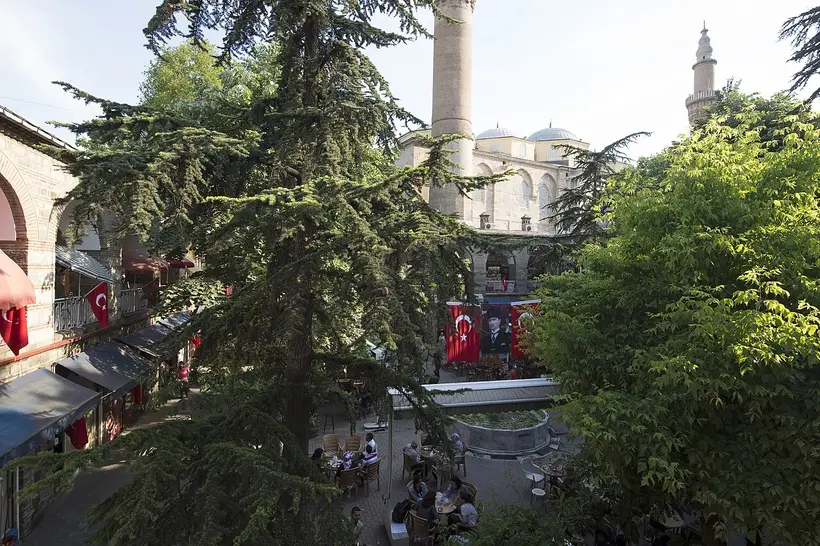
Koza Han, the silk-cocoon caravanserai Bayezid II built in Bursa in 1491, still trading and still serving tea in its courtyard. Photo: Dosseman / Wikimedia Commons / CC BY-SA 4.0
Uludağ and the longest cable car line in the world
Uludağ — Mysian Olympus to the Greeks and Romans — tops out at 2,543 metres, and its national park begins about 22 kilometres south of Bursa. You reach it on the Bursa Teleferik, an 8.2-kilometre line billed as the world's longest, lifting you from Teferrüç at 236 metres to Sarıalan at 1,635 metres and on to the Oteller Bölgesi station at 1,810 metres.
Sources disagree on the ride time: Lonely Planet says 22 minutes for the full ascent, Turkish listings around half an hour. Budget thirty minutes each way plus queueing; the “40 minutes” some tour pages quote counts boarding and the cabin change, not time in the air.
What Uludağ costs in 2026
The operator's tariff is 500 TL for a full round trip and 250 TL for a student one, with a “Kabin Box” at 250 TL per person — a 25% rise on 2025's 400 TL. Published hours are 10:00 to 19:00; third-party listings quote anything from 08:00 to 20:00, so take the operator's figure and confirm on the day, because wind and maintenance close the line at short notice.
Driving in instead, 2026 park entry is 60 TL for a car, 80 TL for a minibus, 300 TL for a midibus and 600 TL for a coach, settled at a PTT branch within 15 days; miss that window and a tenfold penalty is added.
One consequence of the 1,574-metre climb from Teferrüç to the hotels: expect it to be roughly ten degrees colder at the top. People board in August in a T-shirt and regret it before they step out.
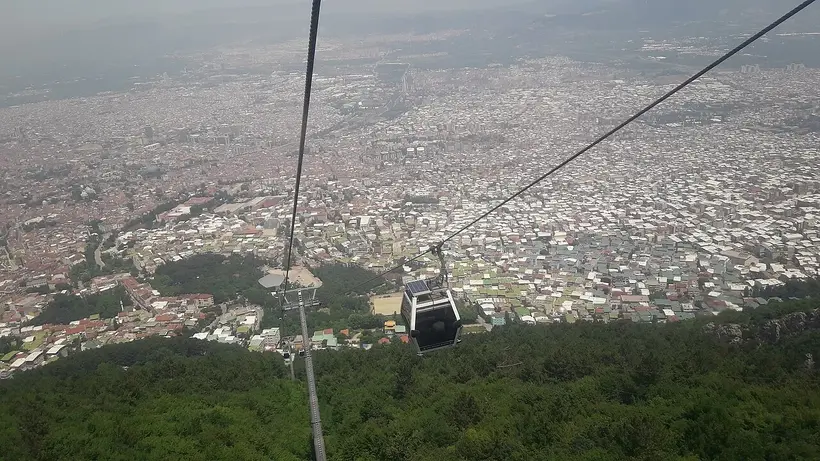
A cabin on the 8.2 km Uludağ Teleferik climbing away from Bursa towards Sarıalan and the Oteller Bölgesi station at 1,810 m. Photo: MOÖbutnotacow / Wikimedia Commons / CC0
Sapanca or Bursa? Choose by what you want the day to feel like
They are not interchangeable, and choosing wrong is the most common way one of these days falls flat.
Take Sapanca and Maşukiye to decompress: the shorter drive, the gentler schedule, the greener one. It suits couples, families with small children, and anyone whose Istanbul week has been heavy on museums. Very little is obligatory, which is the point.
Take Bursa and Uludağ if you want the day to add up to something: a first Ottoman capital, a UNESCO village, a mosque from 1399 and a 2,543-metre mountain in one run. The twelve-hour option at €315 exists because ten hours is genuinely tight once the cable car is in the plan.
If the group cannot agree, Bursa is the better first choice and Sapanca the better second. If the spare day is better spent inside the city, an Istanbul private daily tour will use those ten hours more efficiently than either.
What “private” actually removes from the day
The luxury here is subtractive. You are paying for a list of things that do not happen.
The pickup circuit. A coach spends its first hour collecting strangers from six hotels. Your car leaves your door when you say.
The commission stop. No detour to a carpet showroom that exists to pay somebody else's margin.
The fixed clock. If Cumalıkızık holds you, you stay; if the summit is fogged in, you skip it for Koza Han.
The luggage problem. Six to ten suitcases fit — which matters when the excursion falls on your departure day.
The language gap. A multilingual driver and live WhatsApp monitoring mean somebody is reachable the moment plans move.
The same logic sits behind executive and business transport for travellers on a schedule they do not control, and the romantic Istanbul tour for couples who would rather not spend an anniversary in a party of forty.
When to go
May to mid-June and September to October are the sweet spot for both routes: the Maşukiye valley is green, Bursa is comfortable to walk, and the cable car runs without a ski-season queue. July and August push Istanbul past 30°C — exactly when a station at 1,810 metres and a shaded river valley become the most valuable things on the map. December to March turns Uludağ into a ski resort and Kartepe into a snow day: spectacular, but queues lengthen and wind closures grow likelier.
Five things to settle before you book
Book at least 24 hours ahead. Both tours require it, and a full refund needs 24 hours' notice.
Carry Turkish lira. Cable car tickets, park fees and village breakfasts are local-currency transactions, none of them in the tour price.
Have a wind plan for Uludağ. If the teleferik is shut, Cumalıkızık, Koza Han and the Ulu Cami fill the afternoon.
Pack a layer. Ten degrees colder at the top is not a rounding error.
Agree the finish time in writing. Ten and twelve hours are different days, and the gap is €46.
Get those right and the day collapses into something quietly luxurious: a car at your door in the morning, a lake or a lost Ottoman capital in the middle, your own hotel lobby again by evening — nothing organised by you, and nobody else's itinerary imposed on your day.