
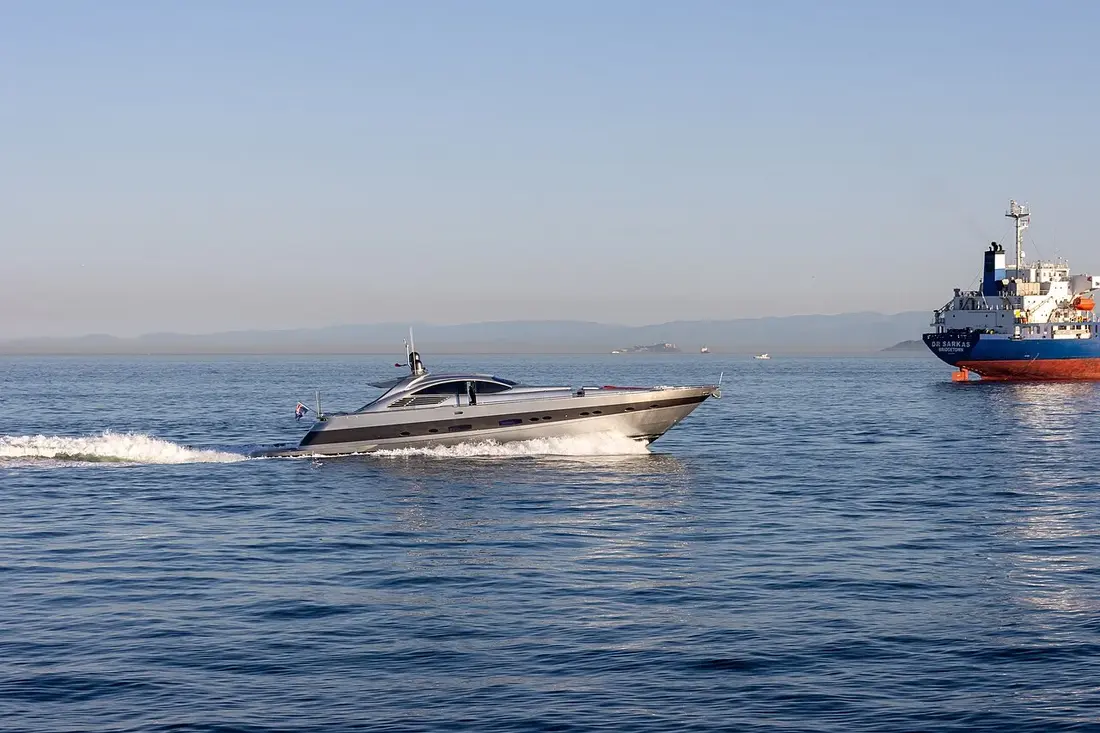
Two very different things are sold in Istanbul under the same word. One is a private yacht hired by the hour, with a crew and a table laid on the aft deck — the water is the point. The other is a boat used exactly like a car, lifting you off a pier near your hotel and onto a pier near your dinner, and earning its fee because it is over in a quarter of an hour. Choosing wrongly is the expensive mistake here — usually a three-hour charter bought to solve a twenty-minute transport problem.
Two products that happen to share a strait
A charter is a venue that moves. You are buying dwell time: the deck, the service, the light, a route shaped around whatever you feel like doing. Nobody charters a yacht to arrive somewhere, which is why they are quoted in hours and almost always carry a two-hour minimum.
A VIP water transfer is the opposite — you are buying the deletion of one measurable problem. In 2025 the TomTom Traffic Index clocked an average of 22 minutes 54 seconds to cover 10 km inside Istanbul, with rush-hour traffic averaging 20.7 km/h. That is the number a water transfer removes.
What you actually charter: the boat, the crew, the minimum
A representative yacht in the Cool Travel Istanbul private yacht and boat fleet runs to 23 metres, takes up to 25 guests (20 is the comfortable working number), and carries two cabins and twin 450 HP engines, with air conditioning and Wi-Fi aboard. It books with or without catering. Three specifications matter more than length:
Is there a galley? A working kitchen serves a plated dinner. Without one the crew reheats what came aboard in trays.
Is there an enclosed saloon? Not a luxury here. The strait funnels wind, and from November an open deck is a twenty-minute novelty rather than a three-hour venue.
How many crew, and doing what? Captain and deckhand are the legal minimum; service staff, a chef and a concierge who handles the pier are separate line items.
What a Bosphorus charter costs in 2026
Published prices contradict each other wildly. Marketplaces advertise Istanbul boats from roughly $95 an hour; Turkish operators publish tariffs around ₺4,000 an hour for 8–15 guests, ₺6,000 for 16–30 and ₺7,000 for larger event boats, fuel and crew included, on a two-hour minimum — about €72, €108 and €126 at the 23 September 2026 rate of €1 = ₺55.73. A crewed yacht of the kind above starts at about €1,500.
Both are accurate; they describe different products. The hourly figures are bare hire of a gezinti teknesi, a sightseeing boat that by legal definition works inside the port area with no swimming or sunbathing service. The four-figure ones are a crewed yacht with a galley, table service and an itinerary. We quote the operator's published figure for the actual vessel rather than a marketplace “from” price, because the latter is always the smallest boat on the quietest weekday hour. The day, the hour, the catering tier and any repositioning move the number from there. For a private evening cruise with dinner aboard, expect a two-hour floor and a Kabataş departure.
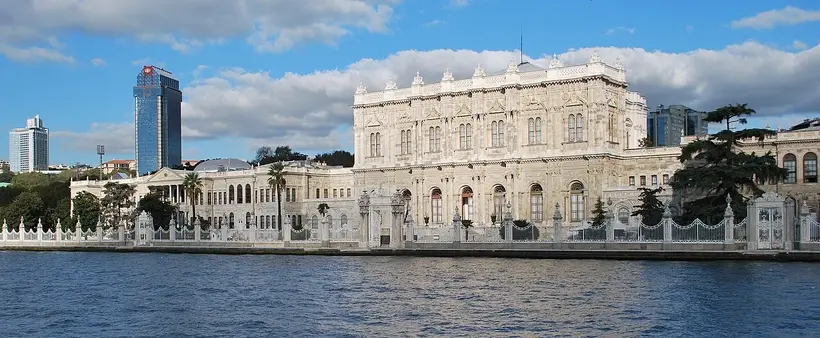
Dolmabahce Palace shows its full 600-metre facade only from the water, which is how it was designed to be approached - photo: Helge Hoifodt / Wikimedia Commons, CC BY-SA 3.0
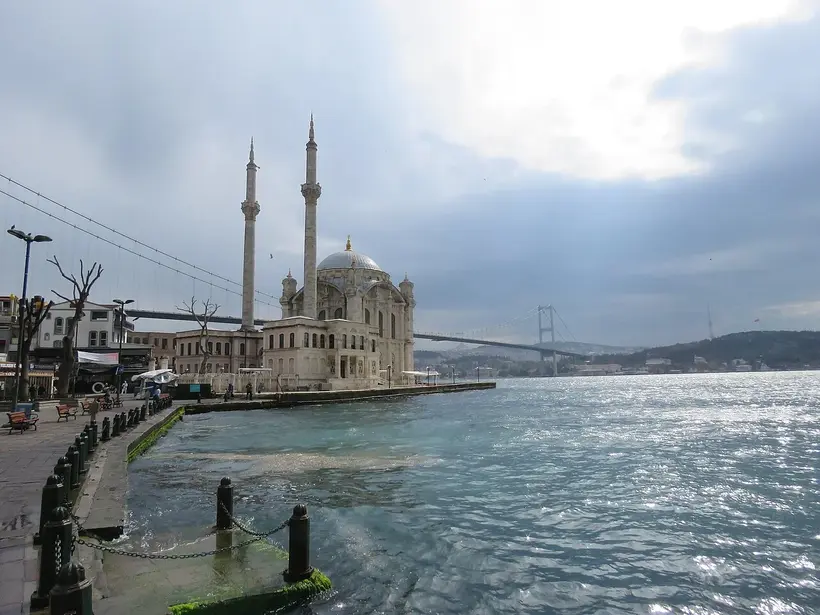
Ortakoy Mosque framed by the 15 July Martyrs Bridge - the most photographed sightline on any Bosphorus charter - photo: Calistemon / Wikimedia Commons, CC BY-SA 4.0
The route: what passes the rail, and in what order
The Bosphorus runs about 30 km and narrows to roughly 700 metres between Rumeli Hisarı and Anadolu Hisarı. A two-hour charter does not run the whole thing. It works the southern third, where the landmarks cluster, and turns back at or just past the second bridge.
Heading north from Kabataş, the European bank gives you Dolmabahçe Palace — a 600-metre waterfront facade that only resolves from the sea — then Çırağan Palace, then Ortaköy Mosque directly beneath the 15 July Martyrs Bridge. Past Bebek bay comes Rumeli Hisarı, the fortress Mehmed II built in four months in 1452, and above it the Fatih Sultan Mehmet Bridge. The Asian bank answers with the Maiden's Tower off Salacak, Beylerbeyi Palace under the first bridge, the Küçüksu Pavilion and the wooden yalı mansions of Kanlıca.
One practical note on the Maiden's Tower, the landmark guests most often ask to stop at: it reopened on 11 May 2023 after restoration, but you cannot tie up alongside in a private boat. Landing is by the dedicated transfer boat from Üsküdar and Salacak only, so plan it as a separate shore excursion.
Timing a sunset charter: the clock moves fast in autumn
Sunset is the slot everyone wants and the one most often booked at the wrong hour, because Turkey has had no daylight saving since 2016 and sits on UTC+3 all year. Istanbul sunset times:
Late September: around 19:00
Mid-October: 18:25
Mid-November: 17:47
21 December: 17:40
Late June: 20:41
The rule: board 75 to 90 minutes before sunset. That buys the run north in daylight, low golden light on the western bank coming back, and the bridge illuminations switching on as you return — three distinct looks from one two-hour booking. Board at sunset itself and you have paid a peak premium for a dark cruise. For a proposal or an anniversary evening, that lead time is the most useful thing on this page.
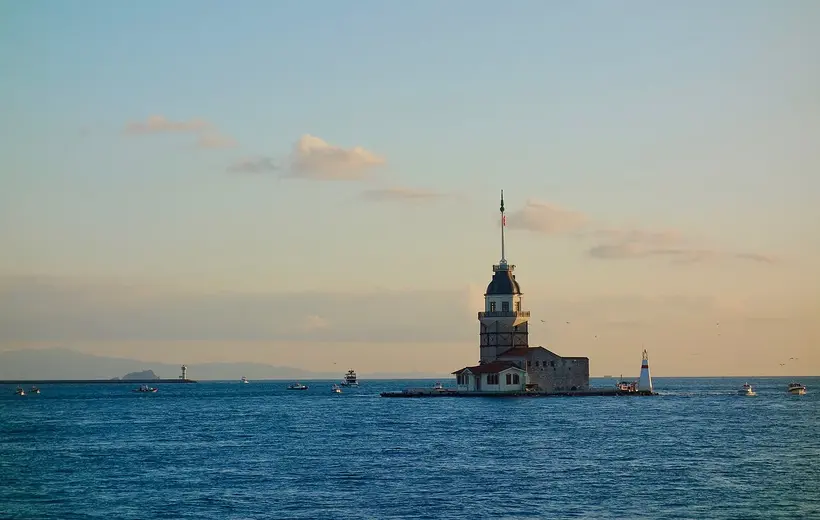
The Maiden's Tower at golden hour. Reopened in May 2023 after restoration, it can be circled by private charter but landed on only via the official Uskudar and Salacak transfer boat - photo: Sonse / Wikimedia Commons, CC BY 2.0
When the water is simply faster: the transfer case
This half of the market gets undersold because it is not romantic — it is arithmetic. Crossing between the European and Asian banks by road means queueing for a bridge; by water it is a straight line. Road times below use Istanbul's 2025 rush-hour average of 20.7 km/h; sea times assume a 12-knot working speed, realistic given that the Turkish Straits traffic regulation caps transit at 10 knots over the ground.
Kabataş to Kadıköy: about 3.1 nautical miles, roughly 16 minutes. By road, 13.7 km and about 40 minutes at peak.
Karaköy to Anadolu Hisarı: about 5.9 nautical miles, roughly 29 minutes. By road, 18.5 km and about 54 minutes.
Kabataş to Sarıyer: about 9.3 nautical miles, roughly 46 minutes. By road, 20.1 km and about 58 minutes.
That list holds the counter-intuitive finding. The water wins decisively on cross-strait and mid-Bosphorus hops, halving the journey. On the long run north to Sarıyer the margin narrows to about twelve minutes, and a chauffeur may be the better call — particularly in weather. Use the water where it is structurally faster and keep an Istanbul private car with driver on call for the rest.
What the sea taxi costs, and how the meter works
Istanbul's municipal sea taxi runs on a published UKOME tariff that works like a taxi meter: a flat ₺500 boarding charge, then ₺750 per nautical mile. It is billed by distance, not by head — one passenger and ten pay the same. Applied to the routes above, that is roughly ₺2,825 (€51) to Kadıköy, ₺4,918 (€88) to Anadolu Hisarı and ₺7,438 (€133) to Sarıyer. Those are worked examples from measured channel distances; the meter aboard, not this page, is the authority.
Capacity is 10 and strictly enforced — arrive with twelve and two stay on the pier. Booking is only through the İBB Deniz Taksi app, up to five days ahead, 24 hours a day, card only. The route cannot change once under way. Cancel within five minutes of booking for a full refund; cancel inside the final hour and you forfeit the fare. Each boat carries a captain and a deckhand, and the bow-landing, step-free design takes wheelchairs and pushchairs straight aboard.
Piers, hotels and the access rule nobody mentions
A private pier is not a public one, and this is the detail that derails well-planned evenings. Several Bosphorus properties have their own landings — Four Seasons at the Bosphorus, Çırağan Palace Kempinski, The Peninsula Istanbul, Mandarin Oriental Bosphorus and Sumahan on the Water among them — and charter operators publish them as pick-up points. But the landing belongs to the hotel, and using it generally requires you to be a resident guest or hold a confirmed restaurant booking; otherwise expect a docking fee, or to be turned away at the fender. Not every waterfront name has one: the Shangri-La Bosphorus boards from Kabataş instead. Treat every published pier list as a starting point and have the venue confirm the landing in writing alongside the table — for corporate evenings that belongs in the same brief as the cars, which is why our executive and business transport service handles both legs.
Weather, licences and what to verify before you pay
The first risk is the lodos, the southwesterly that hits mainly between November and March. It does not merely make for a choppy ride: in January 2026 the strait was closed to shipping for most of a day, reopening only at 17:00, with ferry and sea-bus services cancelled. Get the operator's weather policy in writing — whether a cancellation for wind produces a reschedule or a refund, and who makes that call.
The second is paperwork. Commercial passenger boats in Turkey operate under the Maritime Tourism Regulation and must hold a tourism operating certificate from the Ministry of Culture and Tourism; sea taxis are licensed separately by the municipality. A boat without it is a private vessel chartered informally, and your insurance position after an incident is not what you assume. Ask to see the certificate and the captain's licence — a legitimate operator produces both without hesitation.
So which one should you book?
Book the charter when the boat is the destination: a sunset evening, a dinner for twelve, a corporate reception. You are buying two to four hours of a venue nobody else can enter, and at roughly €1,500 upward for a crewed 23-metre yacht with catering it compares well with a room ashore — better view, no other tables.
Book the transfer when the boat is the shortcut: hotel to a dinner on the opposite bank, a pier-to-pier hop between meetings, a principal delivered to a waterfront venue at 19:00 on a weekday without an hour in the car. At €33 to €88 for most useful hops, it is the cheapest thing here and buys back the most time. For a full itinerary the answer is both — and one evening given to a charter, because the Bosphorus at golden hour is why people come.