
Istanbul is not a city you leave quickly. That single fact decides which day trips are worth taking and which ones look good on a map and then swallow six hours of a weekend in traffic. Get the departure hour right — and the route, and the vehicle — and three genuinely different landscapes sit inside a comfortable day's drive: an Ottoman imperial capital under a 2,543-metre mountain, a lake ringed with spa hotels, and a stretch of Black Sea coast with a 19th-century lighthouse on it.
How far is each one, honestly?
Bursa and Uludağ — roughly 155 km, two to two and a half hours each way via the Osmangazi Bridge. The longest day of the three, and the only one with a mountain at the end of it.
Sapanca and Maşukiye — about 136 km, an hour and a half to two hours on the Anadolu Otoyolu. The easiest drive.
Şile and Ağva — Şile is still legally part of Istanbul, about an hour from the Asian side on the D-020; Ağva is 28 km further east along the coast.
Bursa and Uludağ: an imperial capital with a mountain attached
Bursa was the Ottoman capital before Edirne and long before Istanbul, and UNESCO formalised that in 2014 by inscribing Bursa and Cumalıkızık: the Birth of the Ottoman Empire — eight separate component sites rather than one monument, which is why the city rewards a planned route instead of wandering.
The Grand Mosque, Ulu Cami, was built between 1396 and 1399 under Bayezid I: twenty domes over a single hall, an ablution fountain kept indoors beneath the central dome, and some of the finest large-scale calligraphy in Turkey on its walls. Five minutes away, Koza Han opened in September 1491 under Bayezid II — 104 rooms on two floors around the courtyard that was the trading floor of the Bursa silk road, where an agent of the Medici family kept an office in the early 16th century. Today it is tea tables and silk shops, and the best place in the city to sit for half an hour.
Lunch has an address. İskender was invented here in 1867, when İskender Efendi began turning lamb on a vertical spit in a Kayhan butcher's shop and serving it over pide with browned butter, tomato and yoghurt. Everything sold under that name elsewhere is an imitation of this.
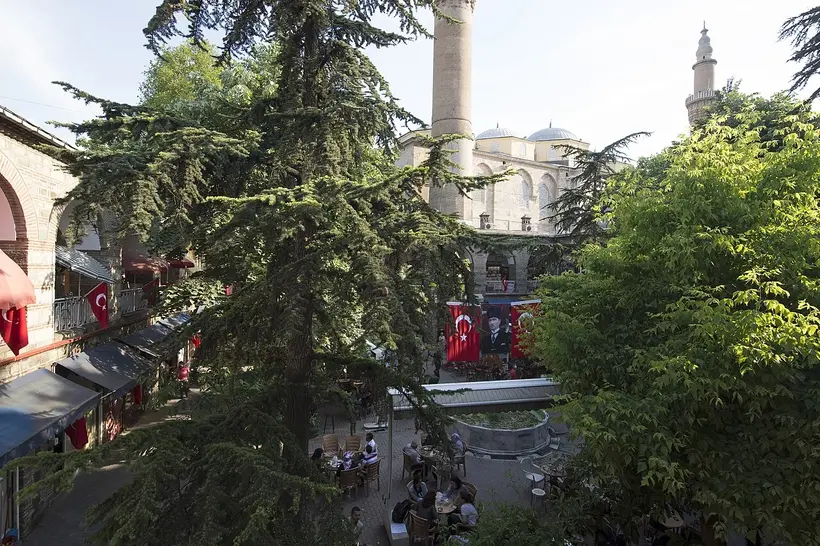
Koza Han in central Bursa, opened in 1491 and still trading silk around its courtyard — photo: Dosseman / Wikimedia Commons, CC BY-SA 4.0
The cable car is the reason to stay until late afternoon
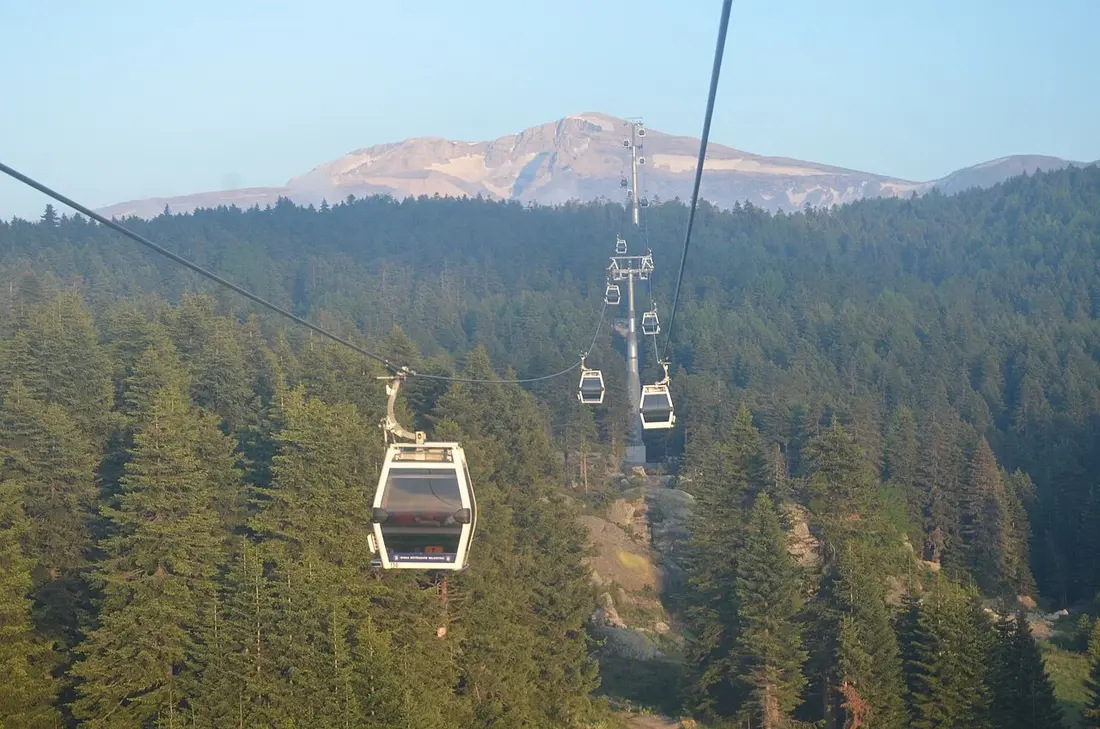
The Bursa Uludağ Gondola is the longest monocable gondola line in the world at 8.8 km, rebuilt by Leitner and reopened at the end of 2013. It climbs in four stages — Teferrüç, Kadıyayla, Sarıalan, Oteller — to a top station at 1,870 m, and takes 22 minutes end to end. The 2026 adult fare is 500 TL, students 250 TL. It runs roughly 08:00 to 20:00 in summer, closes an hour earlier in winter, and stops altogether in high wind — have your driver call ahead rather than arriving on spec.
At the top you are in Uludağ National Park, some 8–10°C cooler than the city below, with the summit at 2,543 m. From mid-December to late March this is a working ski resort — the 2025–26 season ran 13 December to 15 March — and the rest of the year an alpine walk with a view back over the Marmara. A private Bursa and Uludağ day tour exists precisely because the sequence — mosque, han, lunch, cable car, home — collapses if any one leg runs late.
The bridge or the car ferry? A 2026 answer
The fast option is the Osmangazi Bridge on the Gebze–Orhangazi motorway. The car toll has been 1,170 TL since 1 July 2026, VAT included, and it turns the old three-hour crawl around the Gulf of İzmit into a straight two-hour run.
The scenic option is the Eskihisar–Topçular car ferry, which crosses from Gebze to Yalova in 25–35 minutes. A car costs 730 TL one way, dropping to 630 TL between 22:00 and 10:00, and it sails around the clock, every 15–20 minutes at busy times.
What you should not plan on is driving onto a ferry at Yenikapı: those fast ferries to Bursa Güzelyalı carry foot passengers only, so any guide telling you to put a car on a boat in central Istanbul is out of date. The bridge wins whenever the day is tight; the ferry earns its place on the return leg, when 30 minutes on deck at sunset beats another motorway hour.
Sapanca and Maşukiye: the trip you take when you want to do nothing
Lake Sapanca is a tectonic lake of about 47 km², up to 61 m deep, in the corridor between the Marmara basin and the Black Sea. At roughly 136 km it is the shortest of the three drives and the flattest in terms of effort. There is no monument you are obliged to see, which is the point.
The north shore carries most of the serious hotels, several with thermal and spa facilities and lakefront terraces. Ten minutes south, Maşukiye sits at the foot of Kartepe, where restaurants are built out over mountain streams and the default order is trout with a table of meze. Kartepe is a second ski area in winter and a straightforward drive to a viewpoint the rest of the year.
Autumn is Sapanca's season: the forest turns in late October and early November, the summer weekend crowds have gone, and the spa hotels are at their quietest. Our Sapanca and Maşukiye private day tour is built around a late lunch for that reason — the light on the lake between three and five is the thing worth being there for.
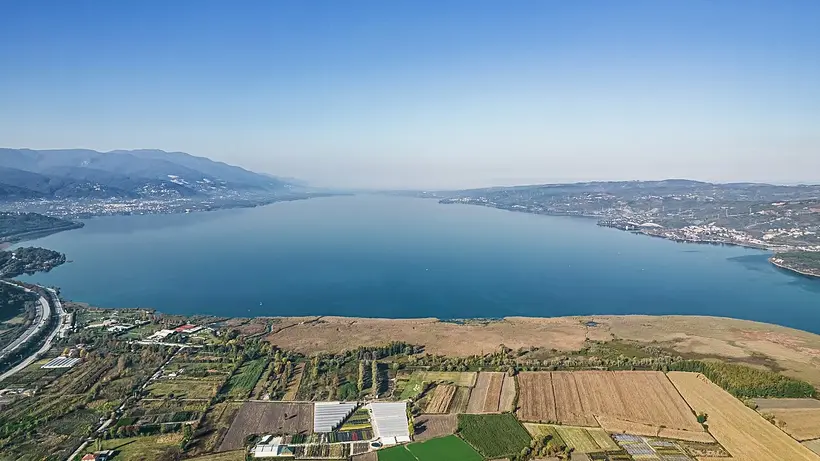
Lake Sapanca from the air: 47 km² of water an hour and a half from Istanbul — photo: A.Savin / Wikimedia Commons, Free Art License
Şile and Ağva: Istanbul's own Black Sea coast
Şile is the trip people forget is available, because it never feels like leaving the city — administratively, it is the city, a district of Istanbul on the Black Sea shore about an hour from the Asian side.
The landmark is the lighthouse. Built in 1859 under a concession granted to the French in the late Ottoman period, it is an octagonal stone tower 19 m tall with walls 110 cm thick, its light 60 m above the sea and visible for 20 nautical miles, banded black and white so ships can pick it out by day. Turkey's Directorate General of Coastal Safety lists it as the country's largest. It stands on a cliff above a dramatic piece of coast and photographs best in late afternoon.
Şile also gives its name to a fabric. Şile bezi is a loose-woven cotton made on hand looms, washed in Black Sea salt water and dried on the sand — a process that opens the weave and is why it feels cool against skin in August. Buy it in the town centre, not in Istanbul.
Twenty-eight kilometres further east, Ağva sits on the delta where two rivers reach the sea: the Göksu to the west and the Yeşilçay to the east. The name means, roughly, the place between the waters, and the town follows from it — small river-facing hotels, wooden jetties, flat-bottomed boats that run slowly up the Göksu between reed banks, and fish on a terrace over the water.
There is no packaged tour for this coast, which is part of its appeal; the usual arrangement is private car hire with a driver for the day, with the itinerary settled around Şile depending on the weather. One warning that is not marketing copy: the Black Sea here has a serious undertow, and the beaches at Ağlayan Kaya, Uzunkum and Ayazma claim swimmers every summer. Swim only where there are lifeguards, and take a red flag literally.
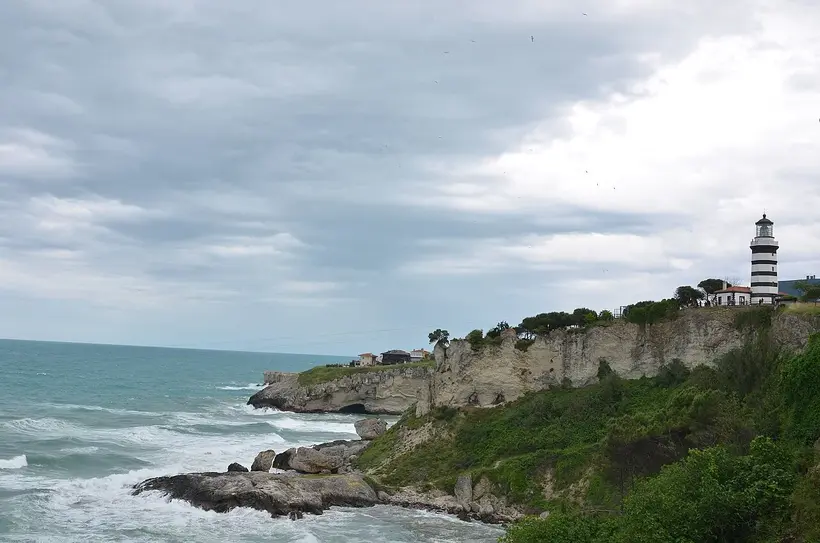
Şile lighthouse, built in 1859 and still Turkey's largest, on the cliffs above the Black Sea — photo: Zach1055 / Wikimedia Commons, CC BY-SA 4.0
So which of the three should you take?
One day, maximum substance. Bursa — the only one with world-heritage architecture, a famous dish and a mountain in the same twelve hours, and the only one that fails if you leave at ten.
Children or elderly parents in the party. Sapanca. Shortest drive, no stairs, no cobbles, somewhere to sit at every stage.
You arrived last night and are tired. Şile and Ağva. An hour out, an hour back, nothing in between that demands anything of you.
Snow on the ground. Bursa, for the cable car and the slopes above Sarıalan.
Late October. Sapanca, for the forest colour around the lake.
July, city at 34°C. The Black Sea coast, where the breeze is the whole point.
What a chauffeur actually changes on these routes
The luxury argument for a private car is usually made in terms of leather and legroom. On these routes the real advantages are duller and worth more.
Departure time is the whole game. Leaving the European side at 07:00 rather than 09:00 takes about an hour off the Bursa run in each direction — no scheduled tour will do that for you.
Tolls are electronic. Turkish motorways and bridges bill through the HGS system, read from a windscreen sticker; a self-drive rental without a valid balance collects penalties rather than a bill.
You are not driving. So the wine with lunch in Bursa and the rakı with the fish in Ağva are actually available to you — and the ferry queue at Eskihisar and the midday parking problem around Koza Han stop being yours.
For the vehicle, the split is straightforward: a Mercedes V-Class if you are four or five with luggage and want to face each other on a two-hour run, a Maybach-class saloon if you are two and the day ends at a business dinner. Cool Travel Istanbul runs these routes as executive private transport as well as leisure day tours, with Wi-Fi on board and no fixed return time.
Before you go
Dress for Ulu Cami as for any working mosque — shoulders and knees covered, shoes off, headscarf for women — and avoid midday Friday prayer. Carry cash for the ferry, the cable car and the smaller shops. Pack a layer for Uludağ whatever the forecast says about Bursa, because 1,870 m is a different climate. And build slack into the return: the Osmangazi Bridge and the Anadolu Otoyolu both back up on Sunday evenings as the city comes home.