
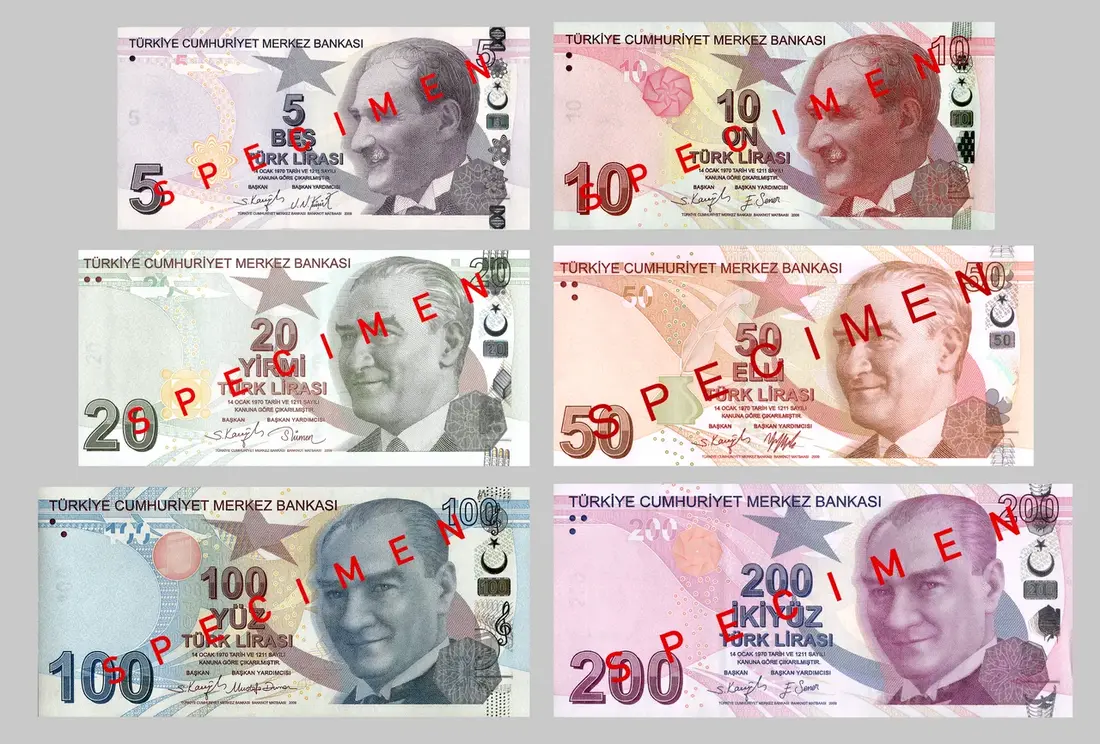
The short answer is no. Tipping is not mandatory in Turkey, and after a change in the law in January 2026 it is more genuinely voluntary here than in almost any country you have travelled from. What exists instead is bahşiş — a cash habit with its own amounts, denominations and etiquette, none of which anyone writes down. Here are the rules, with the 2026 numbers.
Is tipping mandatory in Turkey?
There is no legal obligation to tip anyone here, and no separate lower “tipped wage” of the kind that makes American tipping quasi-compulsory. A waiter in Istanbul is on the ordinary national minimum wage, which for 2026 is 28,075.50 lira net per month — roughly 1,275 lira for a working day, about $26.
Hold on to that figure, because it tells you what your tip means: a 200 lira tip is around 15% of a day's pay. Turkish tipping tops up a real wage rather than replacing one, which is exactly why the amounts stay modest.
What changed in January 2026, and why most tipping guides are now wrong
On 30 January 2026 an amendment to the Price Tag Regulation appeared in the Official Gazette (issue 33153), effective immediately with no transition period. Restaurants and cafes can no longer charge you for servis ücreti (service), kuver (cover) or masa ücreti (table), or for anything else under any other name. You pay for what you ordered, at the menu price.
The Ministry of Trade closed the obvious loophole a week later, warning on 7 February 2026 that folding the old charge into menu prices would not be tolerated either — and fining one Beyoğlu restaurant 1,860,170 lira for doing exactly that. Additional payments are now permitted only on a voluntary basis: tips, in other words.
This matters twice over. Almost every English-language tipping guide still tells you to check the bill for a service charge first; that advice is now obsolete. And a service or cover line printed on your bill today is not an awkward tipping question — it is an illegal charge, and you can refuse it.
Restaurants and cafes: 10% in cash
For table service, 10% of the bill in cash is the baseline that will never be wrong. Published guidance ranges from 5% to 15%, and that range reflects the venue rather than any real disagreement: round up at a neighbourhood lokanta, 10% at a normal restaurant or meyhane, 10–15% at fine dining. A 2,500 lira dinner for two takes a 250 lira tip — about $5, or €4.50.
You owe nothing at self-service canteens, food courts, bakeries or street food stalls. At cafes, round up or drop 20–50 lira in the jar, and skip it without guilt if there is not one.
Why the card machine will not help you
The overwhelming majority of Turkish card terminals have no tip line at all: the waiter hands you the device, you tap for the exact amount, and there is no prompt.
Even where a terminal accepts an added amount, it is the wrong move: a card tip currently counts as business revenue and is taxed as wages with social security deducted, so a meaningful slice never reaches the person you meant to thank. A proposal to fix this — a voluntary tip button, tips tracked separately from turnover and passed straight to staff under a 10% withholding — was still with the Ministry of Treasury and Finance as of July 2026, and is not law yet.
So the rule is blunt: pay the bill however you like, leave the tip in cash.
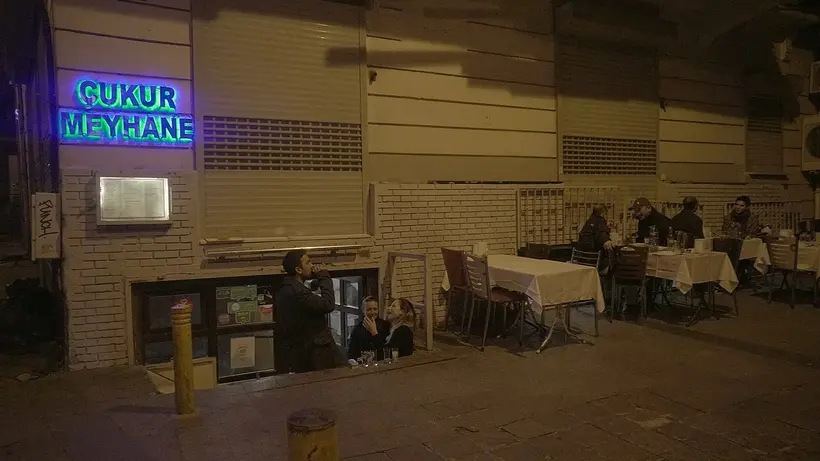
Diners at Cukur Meyhane in Istanbul. Table service like this is the one setting where a 10% cash tip is genuinely expected - photo: Wikimedia Commons / CC BY-SA 3.0
Taxis: round up, do not calculate
Nobody tips a percentage in an Istanbul taxi — you round the fare up to the next convenient note, and that is the entire custom. It helps to know what the meter should say. Since the 10% increase of 20 July 2026, a yellow taxi opens at 71.94 lira, runs at 47.92 lira per kilometre and carries a 230 lira minimum fare; turquoise taxis open at 82.73 with a 265 minimum, and the black luxury class at 122.30 with a 400 minimum.
An eight-kilometre run across town therefore meters at roughly 455 lira. You hand over 500 and do not wait for change — a shade under 10%, with no percentage maths at all. If the meter is not running, that is a fare problem rather than a tipping problem; settle it before you get in.
Private drivers and chauffeurs
A dedicated driver who has you all day is a different arrangement. The customary figure is $10–$20 per day, or around 10% of the daily rate. On a prebooked transfer at a fixed price, 100–200 lira at the door is the normal gesture for someone who loaded your bags, waited at arrivals and did not complain about a delayed flight.
One thing travellers routinely get wrong: the driver's tip is separate from the guide's. Different people, different jobs, often different companies, and one tip is not understood to cover both. A tip is also never a way of settling the fare — when you book private car hire with a driver in Istanbul on a 4 to 12 hour basis or a corporate transfer for executives and conference guests, the quoted price is the price.
Private tour guides: $20–$40 a day, for the group
The standard for a private guide is $20–$40 per day, and the detail that saves families real money is that this is a group total, not a per-person figure: a couple with a guide for a day is one $30 tip, not two. For a guide who genuinely made the trip, $50 and up is a real compliment. Group coach tours spread the cost instead — roughly $5 per person per day for the guide, $3 for the driver.
Guides here sit a state examination and carry a licence, so the person walking you through the Hippodrome on a privately guided historical Istanbul tour is a qualified professional rather than a hired talker. Budget separately for specialists: a guide hired for a single museum is a $15–$20 job, and a hot-air balloon pilot on a Cappadocia highlights tour is customarily $10–$20 per couple, handed over after landing.
Hotels: per bag, per night, per favour
Bellboys and porters: 100 lira per bag. Sources split between 50–100 and 100–200 lira; at 2026 exchange rates the lower end is barely $1, so 100 per piece is the figure that holds up. Make it 200 at a five-star.
Housekeeping: 100 lira per night, left on the pillow daily rather than in a lump at checkout — staff rotate, and one envelope on the last morning usually reaches the wrong person.
Concierge: nothing for a map or a taxi. 200–400 lira when they have actually pulled something off — a table somewhere that said it was full, tickets that were sold out.
Room service: 10% in cash to the person at the door.
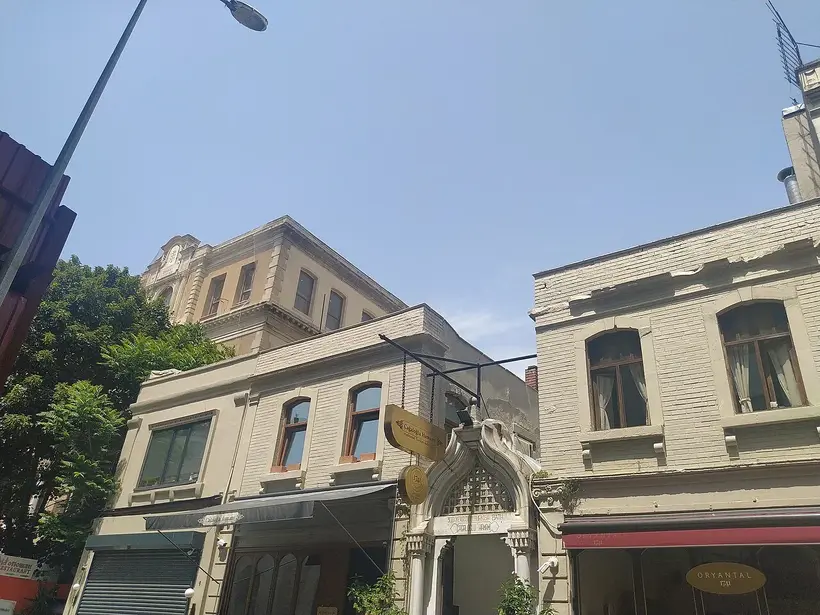
Cagaloglu Hamami in Istanbul, a Turkish bath in continuous use since the 18th century. Hamam attendants are tipped 10-15% of the package price - photo: Wikimedia Commons / CC0
Hamams and spas: 10–15% of the package
A traditional Turkish bath is personal service and is tipped accordingly: 10–15% of the package price. Some guides push 15–20%; treat that as the top of the range for a long oil massage, not the norm for a scrub and foam wash. On a typical €80 package that is €8–€12, roughly 450–670 lira. The historic hamams — Çemberlitaş, built by Mimar Sinan in 1584, and the eighteenth-century Cağaloğlu — quote in euros and revise their lists often, so check their own sites for the current price.
Etiquette matters more than the percentage here. Several attendants often line up as you leave, which is intimidating if you are not expecting it — but you are not tipping each of them. Hand one pooled tip to the tellak or natır who actually scrubbed you.
Which notes to carry, and the one rule you must not break
Turkish tipping runs on 50, 100 and 200 lira notes, and the 200 is the largest in circulation. Break big notes early: ATMs hand out 200s, and a bellboy cannot make change for one.
Never tip in foreign coins. This is not etiquette but arithmetic: Turkish banks and exchange offices will not convert foreign coins at all, at any rate. A handful of euro cents is not a small tip, it is unspendable money, and it reads as an insult even when none was meant. Foreign banknotes are another story — dollars and euros are welcome for the larger guide and driver tips, which is why those are quoted in dollars.
Think in percentages rather than memorised lira figures. The lira has lost close to 18% against the dollar in twelve months and sits near 48.7 to the dollar and 55.9 to the euro as this is written, so fixed lira amounts in older articles are already wrong.
The handover is quick. Fold the notes once, pass them directly to the person who served you, brief eye contact, teşekkür ederim. Do not announce the amount or count it out in front of other guests — discretion is the point.
When you should not tip at all
Self-service counters, food courts, bakeries and street food.
Public transport — buses, metro, tram and the municipal ferries.
Government offices, museum ticket desks and pharmacies.
A guide or driver who has steered you into a carpet shop — that detour already earns them a commission.
Any bill printed with servis ücreti or kuver — illegal since January 2026.
The cheat sheet
Restaurant, table service: 10% cash; 10–15% at fine dining
Cafe: round up, or 20–50 lira in the jar
Taxi: round up to the next 50 or 100 lira
Private driver: $10–$20 per day, or 100–200 lira on a fixed-price transfer
Private guide: $20–$40 per day for the whole group
Group tour: $5 per person per day (guide), $3 (driver)
Bellboy: 100 lira per bag • Housekeeping: 100 lira per night
Hamam: 10–15% of the package • Balloon pilot: $10–$20 per couple
Getting this wrong is not a catastrophe. Turkish service culture is hospitable rather than transactional, and a guest who tips a little light is forgiven instantly. On our private yacht and boat charters in Istanbul, as on every transfer we run, nothing is added to your bill. Carry a few 100 lira notes, tip the people who actually looked after you, and stop thinking about it.