
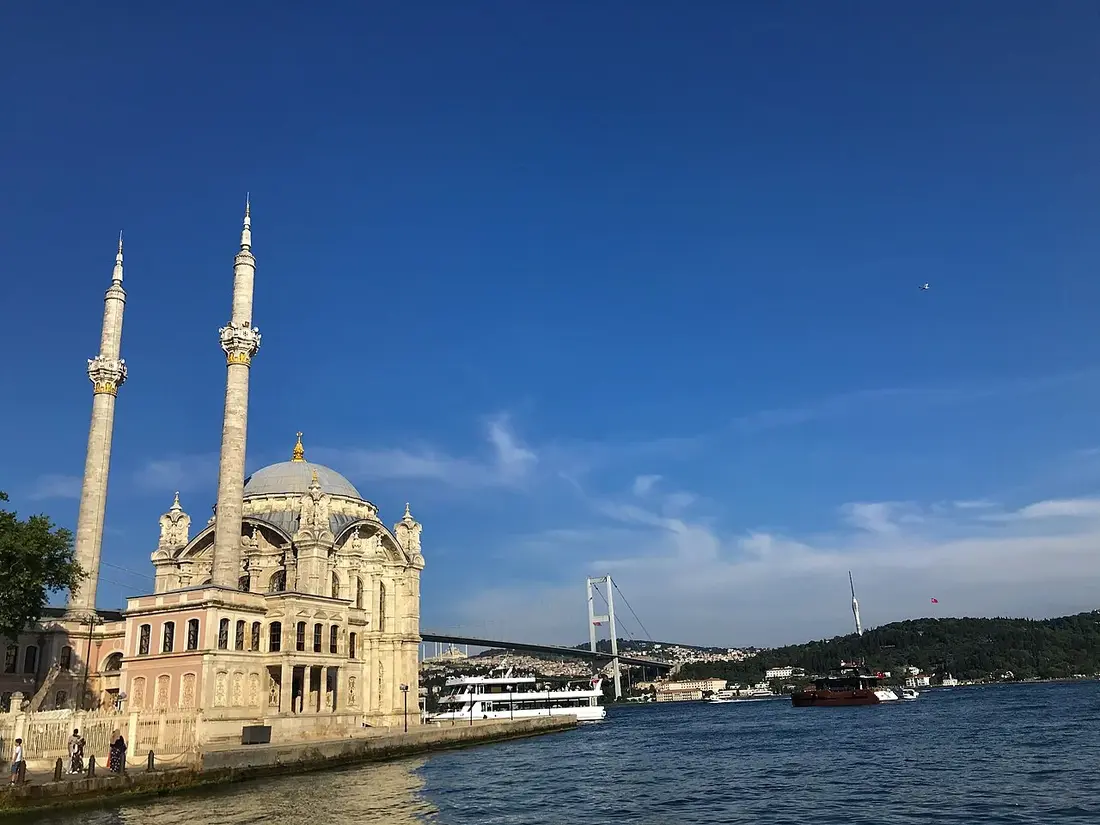
Ortakoy Mosque, Sultanahmet Square, Balat's Kiremit Caddesi, the lanes under Galata Tower. Every guide lists them, which is the problem: by the time you arrive, forty other phones are pointed at the same wall. What separates a frame that stops a scroll is almost never the location – it is the hour, the direction you faced, and knowing what the building actually looks like right now.
First, the only two windows that matter
Türkiye dropped daylight saving in 2016, so Istanbul sits on UTC+3 all year and the light is predictable. Blue hour is the civil twilight band, 26 to 33 minutes either side of the sun. Below, for central Istanbul: blue hour start / sunrise — sunset / blue hour end.
Mid-January: 07:56 / 08:25 — 18:01 / 18:30
Late March: 06:38 / 07:04 — 19:17 / 19:43
Mid-May: 05:15 / 05:44 — 20:16 / 20:45
Late June: 04:58 / 05:30 — 20:41 / 21:13
Mid-August: 05:44 / 06:12 — 20:05 / 20:33
Mid-October: 06:47 / 07:14 — 18:25 / 18:51
Mid-November: 07:22 / 07:50 — 17:47 / 18:15
Late December: 07:54 / 08:23 — 17:40 / 18:09
From November to February you can shoot a full sunrise and still be at breakfast by nine. In June you must be in position by 05:00 – which is exactly why nobody is.
1. Ortakoy Mosque: shoot sunrise, because sunset belongs to everyone else
The Büyük Mecidiye Mosque stands on a stone platform pushing into the Bosphorus, the 15 July Martyrs Bridge rising behind it. Its waterfront face looks east across the strait, so first light comes up over the water and lands directly on the facade and minarets. At sunset the sun is behind you: the building goes flat while the square fills up.
Visitors 09:00–18:00, closed briefly at each of the five prayer times, open for worship 04:00–22:00, free. You need not go inside – the frame everyone wants is from the public promenade, which never closes.
Where to stand, and what to bring
The classic frame: from the promenade on the square side, looking along the shoreline until the minarets separate from the bridge towers. Shoot 24–35mm: wider and the bridge shrinks to nothing, past 50mm you lose the platform.
The low angle: drop to sea-wall height so water fills the bottom third. On a calm morning you get a usable reflection of the dome.
Props: a loaded kumpir runs 150–250 lira in 2026, but the stalls are shut at dawn. Buy cay from an early cafe for the tea-glass foreground; shoot the food once the neighbourhood wakes, around 08:00.
Seagulls: they line the sea wall and lift as a group if you toss simit crumbs. Burst mode, 1/1000s or faster, one keeper in thirty.
For the reverse angle you need a boat: a private yacht charter on the Bosphorus or an evening Bosphorus cruise with dinner gives you the water-level perspective no lens buys from shore.
2. Sultanahmet Square: photograph the Blue Mosque, not Hagia Sophia
Hagia Sophia is wrapped in scaffolding. The structural restoration covers roughly 11,000 square metres across the northern, eastern and southern facades plus one minaret. The north-eastern minaret was dismantled below its balcony and rebuilt stone by stone. The dome sits under a temporary steel frame and a grey covering; inside, four supports rise from the floor toward it. The gallery mosaics stay visible and the building stays open, but the wide clean exterior portrait is off the table – Turkish reporting in 2026 puts many stages of the work into 2027.
The Blue Mosque is finally clear. It reopened for worship on 21 April 2023 after nearly five years of restoration, the minaret scaffolding is long gone, and both courtyards are open – only the Hünkar Kasri pavilion stays closed. Entry is free, tourist windows run 08:30–12:15, 13:45–16:30 and 17:30–18:30, and it shuts to visitors on Friday mornings until roughly 14:30.
Why 07:30 is not the same as 09:00
Coaches start unloading around 08:00, and cruise traffic compounds it: Galataport processes up to 15,000 passengers a day across 980 metres of quay, with roughly 200 calls and 520,000 cruise visitors expected in 2026. At 07:30 you get the fountain, empty gravel and six minarets to yourself; at 09:00 you are photographing the backs of strangers.
Shoot the Blue Mosque from near the fountain at 16–24mm to hold all six minarets. Then turn around and use Hagia Sophia's stonework as a foreground rather than a subject – a gap between the buttresses with domes stacked behind beats the scaffolded facade every time. A guided historical Istanbul tour covers the same ground with the context attached.
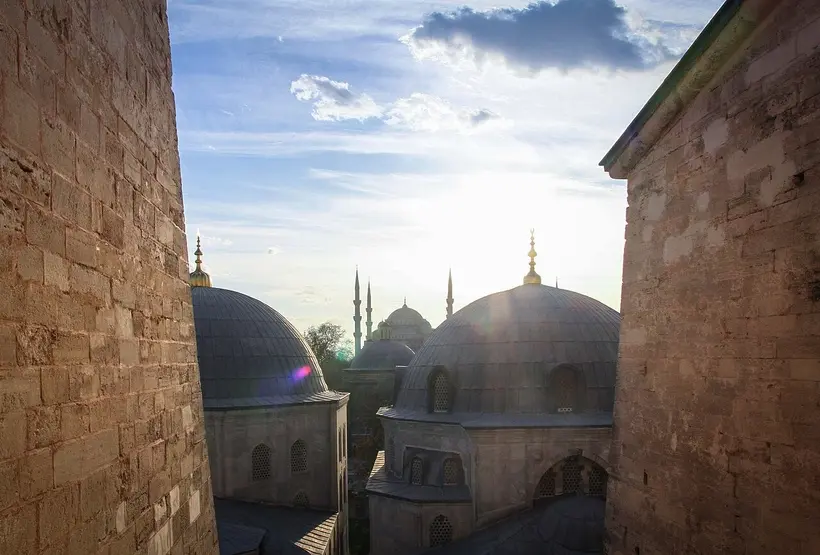
The Blue Mosque framed through Hagia Sophia's stonework - a stronger 2026 composition than the scaffolded facade itself. Photo: M. PINARCI / Wikimedia Commons / CC BY-SA 3.0
3. Balat's Kiremit Caddesi: a two-hour window, weekdays only
Balat's pastel terraces face east and take clean, soft light from sunrise until the sun climbs behind the ridge – in practice 08:00 to 10:00. By late morning at a weekend, Kiremit Caddesi and the stepped lane of Merdivenli Yokus carry a genuine queue of people waiting their turn on the steps.
Stand at the bottom. Both streets slope up, and shooting from the low end stacks the facades into a single wall of colour. From the top, the same street reads as an ordinary row of houses.
Use 35mm or your phone's main lens, not the ultrawide, which stretches the houses at the frame edges and throws away the stacking you walked downhill to get. It is the most common reason Balat photos look worse than the street did.
Vodina Caddesi and Yildirim Caddesi are better late-morning: cafes, shopfronts and real street life rather than a facade you wait to clear.
Overcast helps. Flat light saturates the paint and kills the hard shadow that cuts these narrow streets in half at midday. Rain is better still – wet cobbles double the colour.
Two rules matter more than any of that. People live behind these doors: photograph the houses, not into them, and never block a doorway. And do not fly a drone – between the 9 km exclusion zones around both airports, Bosphorus corridor restrictions and the ban over historic sites, there is effectively nowhere legal to fly in the city.
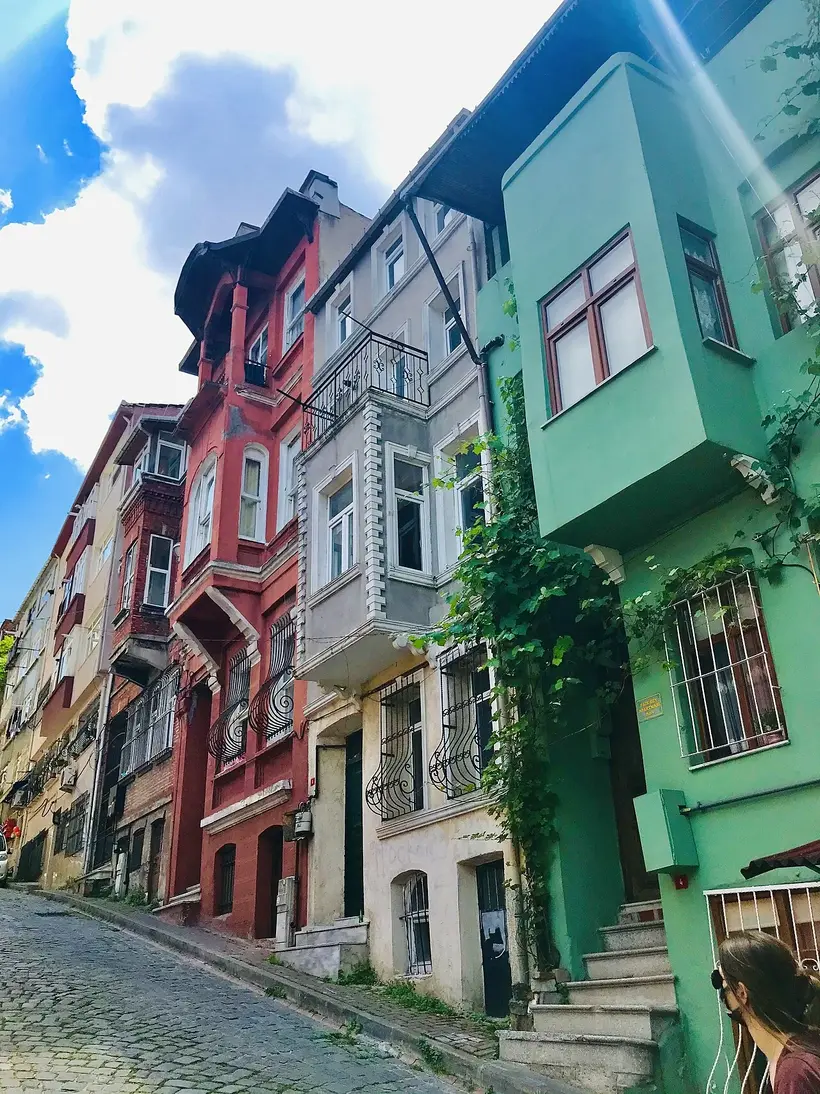
Pastel terraces on a Balat slope, shot from the low end of the street so the facades stack into one wall of colour. Photo: Maurice Flesier / Wikimedia Commons / CC BY-SA 4.0
4. Galata Tower: the lanes below beat the view from the top
Entry is €30 for foreign visitors, 650 lira for Turkish citizens, open 08:30–23:00 with last admission at 22:00. Museum Pass Istanbul covers daytime only: the ticket office cuts pass holders off at 18:14, and the evening Night Museology session (18:30–23:00) costs a separate 200 lira.
The deck is a narrow ring, it queues, and it shows you a city that does not contain the thing you came to photograph. The tower is the subject, and its best frames are free, at street level.
The lane that does the work
Serdar-i Ekrem Caddesi is minutes from the base and it is the shot: a cobbled corridor of 19th-century blocks with projecting bay windows, narrowing until the tower's cone closes the gap. Shoot from the middle of the road at 28–50mm so the cobbles lead the eye. By 07:00 it is genuinely empty; by 10:00 the cafes have their tables out. Galip Dede Caddesi, climbing from the Golden Horn side, sets the tower above a foreground of shopfronts.
Shoot at blue hour, not after dark: the tower is floodlit while the lanes glow warm, and that contrast is the whole image. Wait for a black sky and the tower becomes a white blob on nothing.
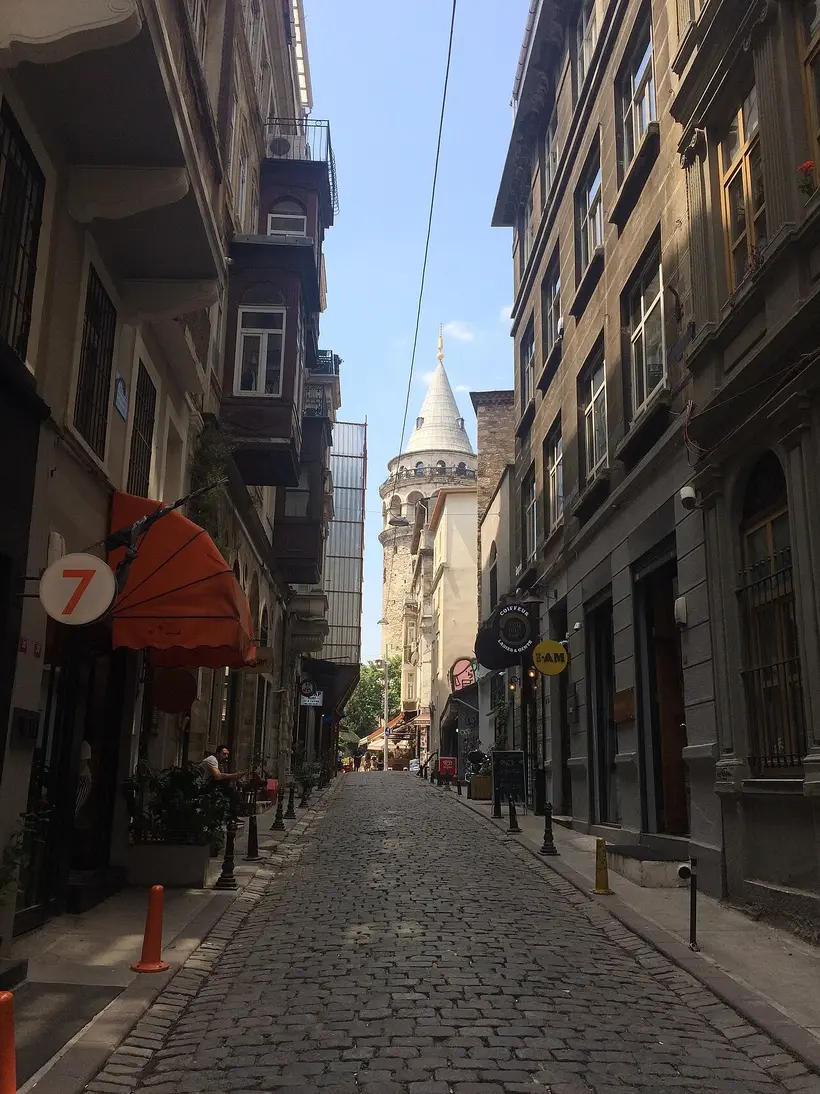
Serdar-i Ekrem Caddesi at street level, cobbles leading to Galata Tower's cone. The frame is free, and empty before 07:00. Photo: Iremnkync / Wikimedia Commons / CC BY-SA 4.0
5. Rooftops: a restaurant terrace and a photo studio are different purchases
These two get recommended in the same breath and they are not the same product.
Seven Hills Restaurant – the view, with a bill
On the roof of the Seven Hills Hotel in Sultanahmet, minutes from the square, roughly 80 indoor and 120 terrace seats. A genuine 360-degree panorama: Hagia Sophia one side, the Blue Mosque the other, the Marmara behind. Open breakfast to late dinner, Turkish breakfast set around 600–800 lira per person. Terrace tables need a reservation and even hotel guests get no priority. Sunset is the busiest slot by a distance; early morning is when you can take your time.
Taht Istanbul – you are paying for the shoot, not the meal
Taht is not a restaurant. It is a rooftop photo studio near Süleymaniye and the Grand Bazaar, open since 2018, with eight shooting areas including the open roof. Published 2026 packages: €140 solo rooftop and light room, €200 for a couple, €250 and €350 premium solo and couple, €160 per person full studio, €300 for video, and €550 solo or €650 couple for the sunrise-only super package. Costume or evening dress adds €30. No deposit; pay in the studio by cash or card.
Want a table, a view and your own camera? Seven Hills. Want a professional shooting you with a flying dress and the skyline behind? The studio price is the honest cost of an image that is hard to make alone – and those couple sessions pair naturally with a romantic Istanbul tour.
Can you do all five in one morning?
Yes, but only with a car, and only in this order – the sequence is set by which way each spot faces the sun.
Ortakoy at blue hour and sunrise. East-facing, so it has to be first.
Balat by 08:00 – roughly 12 km across the Golden Horn, 25 to 35 minutes by road at that hour against an hour by 10:00.
Galata's lanes around 09:00, about 5 km back east, before the cafes set up.
Sultanahmet last, accepting the crowd — or moved to the front at 07:30 if the square matters more than Ortakoy. You cannot have both at their best on one morning.
A rooftop for late afternoon and evening blue hour, booked ahead.
Public transport cannot deliver this: the T1 tram and Marmaray both start at 06:00, fine in December and two and a half hours too late in June. Hence the case for hiring a private car with a driver for four to twelve hours – it waits while you shoot, your gear stays locked in the boot between stops, and the driver knows which end of Kiremit Caddesi to drop you at.
Quick answers
What to carry: 16–24mm for Sultanahmet and the Galata lanes, 35mm or 50mm for Balat and Ortakoy, a small tripod for blue hour, a scarf for mosque interiors (none is lent at Hagia Sophia), cash in lira.
Which are free? Ortakoy, Sultanahmet Square and Balat. Only Galata Tower (€30), Hagia Sophia's gallery (€25) and the rooftops charge.
Is the Museum Pass worth it here? Partly – it covers Galata Tower in daylight but is not valid at Hagia Sophia.
Best month? October and November: sunrise between 07:14 and 07:50, soft low light, summer crowd gone.
Worst plan? Sultanahmet at 11:00 on a Saturday with cruise ships in port.