
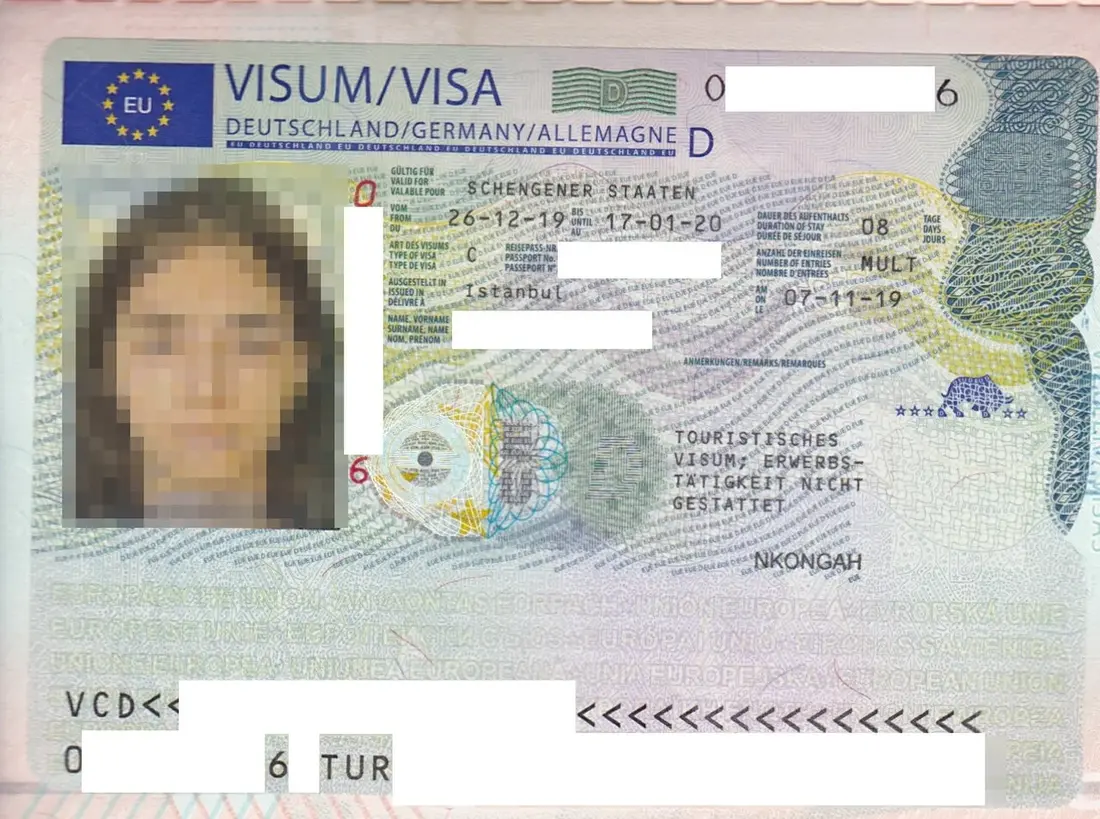
If Istanbul is your base, the European Union has taken a decision that will eventually change how you get to Europe. The Schengen visa — the sticker glued into a passport page — is being abolished, replaced by a cryptographically signed barcode applied for through one EU-wide website. That is the headline; the detail matters more, because nearly every version of this story online gets the date wrong.
What the EU actually announced, and what it did not
The legal instrument is Regulation (EU) 2023/2667, adopted on 22 November 2023 and in force since 27 December 2023. It rewrites the Visa Code, the Visa Information System regulation and the Entry/Exit System regulation in one pass.
The regulation is law already. The system it creates is not running. The European External Action Service is explicit that the platform “will start operating in 2028”, and that until then applicants should follow the existing procedures of the relevant embassies. Articles promising a 2026 launch are quoting the development timetable, not the launch date.
One date is worth your calendar: the Commission must report progress to the European Parliament and the Council by 1 December 2026, and annually after. That report is where slippage surfaces first — and since the EU’s other new travel system has slipped six times, slippage is the base case.
How the EU Visa Application Platform will work
The EU Visa Application Platform, or EU VAP, is designed as a single front door:
One portal, any destination. The platform itself works out which member state is competent to examine the file.
Documents uploaded, not carried. Passport page, bookings, insurance and supporting documents go in as digital copies.
The fee is paid on the platform. No cash desk, no separate transfer.
A status you can check, instead of three weeks of silence.
For anyone who has queued in Gayrettepe clutching a wallet of hotel reservations, that is a real improvement — and still five to seven years away, for a reason the announcements bury.
The sticker becomes a 2D barcode
Today a Schengen visa is a physical sticker carrying a photograph, laminated onto a passport page. Under the new rules visas are issued in a uniform digital format only, as a 2D barcode holding the applicant’s facial image and signed cryptographically by the issuing member state’s certificate authority. Two consequences matter in practice: a full passport stops being a problem, because nothing is glued in; and a lost passport no longer destroys the visa, because the visa is now a record rather than an object.
Who still has to turn up in person
This is the part most often oversold: digital does not mean nobody visits a consulate. You will still appear in person if any one of these is true:
You are a first-time Schengen applicant.
Your biometric data are no longer valid.
You are travelling on a new travel document.
The second point is where the widely quoted figure of 59 months comes from. Fingerprints held in the Visa Information System can be re-used for 59 months from the day they were taken: give fingerprints in Istanbul in March 2026 and they stay usable until roughly February 2031, after which you are back at the counter. This rule exists today — EU VAP does not invent it, it makes the no-appointment route the default for everyone who already qualifies.
The seven-year catch nobody puts in the headline
Here is the clause that turns “2028” into something much longer. The regulation grants member states a transitional period of seven years from the date the platform starts operating, during which a state may simply decline to use EU VAP — the stated purpose being to let governments amortise what they have already spent on national visa portals. A state that wants to move sooner can opt in early by notifying the Commission and eu-LISA.
Do the arithmetic: if the platform goes live in 2028, a member state may keep its own system until 2035. The early 2030s will be a patchwork — some consulates on EU VAP, others still sending you to a national portal and an outsourced centre. Hence the most useful rule here: check the consulate of your actual destination, not the EU press release.
And in October 2026 nothing has changed at all. EU VAP does not exist as a public service; any website offering to file your “digital Schengen visa” today is selling form-filling for a procedure that still ends at a consulate counter.

The Consulate-General of Germany in Istanbul. Germany and Italy route their Türkiye applications through iDATA, and Germany refused 21.1% of applications lodged in Türkiye in 2025 - photo: Maurice Flesier / Wikimedia Commons / CC BY-SA 4.0
Can you even apply for a Schengen visa from Türkiye?
This is the question that actually matters if you are a foreign national based in Istanbul, and it is settled by the Visa Code rather than by goodwill. The general rule: consulates accept applications from people who lawfully reside in their jurisdiction. If you hold a Turkish residence permit — an ikamet — Türkiye is where you apply, whatever your nationality.
If you are merely legally present on an e-Visa or a visa-free stamp, the Commission’s own Visa Code Handbook says an application may be accepted from a non-residing applicant only if they justify why it could not be lodged where they live, and that it is for the consulate to judge that justification. Discretionary, in other words, not a right: “I happen to be in Istanbul and it is convenient” is not a justification. So the residence permit is the pivot, and the rules on which addresses can be registered for a short-term permit change often and vary by district — check goc.gov.tr before signing a lease.
The numbers that will actually decide your trip
Set 2028 aside. These figures govern an application filed from Türkiye today:
The visa fee is €90 for anyone aged 12 or over, €45 for children aged 6 to 11, free below 6. Unchanged since 11 June 2024.
A service fee sits on top. Applications are outsourced: iDATA handles Germany and Italy across nine Turkish cities including Istanbul, others use VFS Global or BLS. Budget roughly €30–35 per person on top.
An appointment is a waiting list, not a booking. Since 25 July 2024 iDATA allocates slots from a queue; when yours comes up you have 48 hours to confirm and pay before it returns to the pool.
Four to eight weeks is the realistic wait for an Istanbul, Ankara or İzmir appointment through 2026. Treat it as the long pole of the trip.
Refusals are not rare. In 2025, 1,268,376 Schengen applications were lodged in Türkiye — more than from any country except China. 14.6% were refused, up from 14.5% in 2024. Of the 1,072,054 issued, 736,556 were multiple-entry.
The consulate you choose changes the odds. On applications filed in Türkiye in 2025, Portugal refused 3.5% and Germany 21.1% — a six-fold spread. Greece received the most, 310,920. Reporting on the same Commission dataset puts Malta highest at 34.8%, on a far smaller caseload.
Those last two points are the most actionable thing here: a four-to-eight-week queue plus a one-in-seven refusal rate means a European side-trip must start two months ahead — and should never be the load-bearing part of your plans.
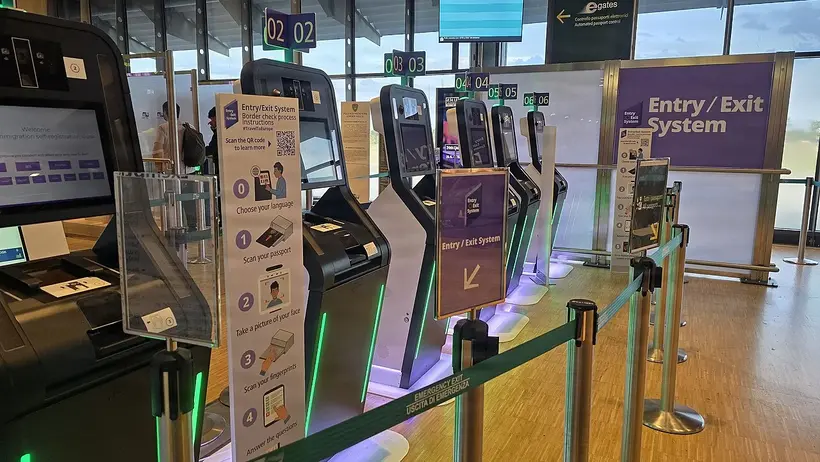
Entry/Exit System self-registration kiosks at a European border: scan the passport, photograph the face, scan four fingerprints. EES replaced passport stamps entirely on 10 April 2026 - photo: Randall Jackson, U.S. Army / public domain
ETIAS and EES: the two systems people confuse with this one
Three EU systems are changing at once, and conflating them is the commonest mistake in this subject.
EES — live now
The Entry/Exit System began a progressive rollout on 12 October 2025 and has been fully operational since 10 April 2026. It covers every non-EU traveller crossing a Schengen external border, visa holder or not. Passport stamps are finished; the border records your facial image, four fingerprints and passport data, and the system calculates your 90-days-in-any-180 allowance itself. Records are kept three years and one day after your last exit, and refusing biometrics means refused entry. Your 90/180 count is now arithmetic, done by a machine that does not forget.
ETIAS — not live, and not this year
ETIAS is a travel authorisation for visa-exempt nationals — American, British, Canadian, Japanese passport holders and so on. It is not a visa and has nothing to do with EU VAP. The EU abandoned its last-quarter-2026 target in July 2026, and the official portal now states only that ETIAS is not in operation and no applications are being collected. 2027 is the current expectation, with no confirmed date. The fee will be €20, raised from €7 in July 2025, with under-18s, over-70s and certain family members of EU citizens exempt.
The sorting rule is simple. If your passport needs a Schengen visa, ETIAS will never apply to you. If your passport is visa-exempt, EU VAP never will.
The Istanbul-shaped takeaway
Until 2028 you apply the old way: €90 plus the service fee, eight weeks of lead time, lodged where you legally reside, in person if you have never given fingerprints. Treat the appointment as the one fixed point and build around it. Istanbul’s consulates and visa centres are scattered between Gümüşsuyu, Beşiktaş and Levent, so a private car and driver booked by the half-day turns three addresses and a biometrics appointment into one morning rather than a day lost to traffic; if you are pairing an application with meetings, the executive transport service covers the same ground on a corporate booking.
And if the answer takes longer than you hoped, Türkiye is not a bad place to be held up: four to eight weeks leaves room for a Cappadocia trip, a day across the Marmara in Bursa and up Uludağ, or the guided walk through historic Istanbul you have been postponing since you arrived. One closing caveat: nothing here replaces your destination consulate’s own instructions. Brussels has announced the architecture; the consulates still own the queue.